
For years I avoided this trip – to the bewilderment of many friends and acquaintances. After all, we are talking about Paros, for many – if not most – a jewel of the Greek islands. Few islands have experienced such a surge in popularity in recent years as this one in the heart of the Cyclades.
In just four hours, sleek high-speed ferries connect it to Piraeus; add to that numerous flights to Athens and other international destinations – in short, Paros is exceptionally well connected and, in travel journalism, long mentioned in the same breath as Mykonos and Santorini.
And that, precisely, was the main reason for my long-cultivated reluctance to return. That I have now – astonishing as it sounds – set foot on Paros again for the first time in 25 years has to do with an obligation of a broadly legal nature. It concerns a property largely forgotten for nearly three decades. More on that later.
I do not know how it is for you, but over the years I have developed personal relationships with certain places. Emotion plays its part. Paros is such a place for me. Over many years – taken together, decades – I spent beautiful, at times unforgettable stretches there with those dearest to me. My attachment to the island goes back to the 1970s. I was living in Athens with my parents and my sister, working toward my Abitur at the German School of Athens.
At the time, my parents invested in a summer house on Paros, a villa right by the sea within walking distance of Parikia, the town where, even then, everything happened. The villa already belonged to the so-called “Germanika,” the German houses. Not because of us, but because of the original builders – a group of enterprising compatriots who had met in Ethiopia and came up with the idea of buying land on a Greek island and setting their Cycladic-style holiday homes into the landscape.
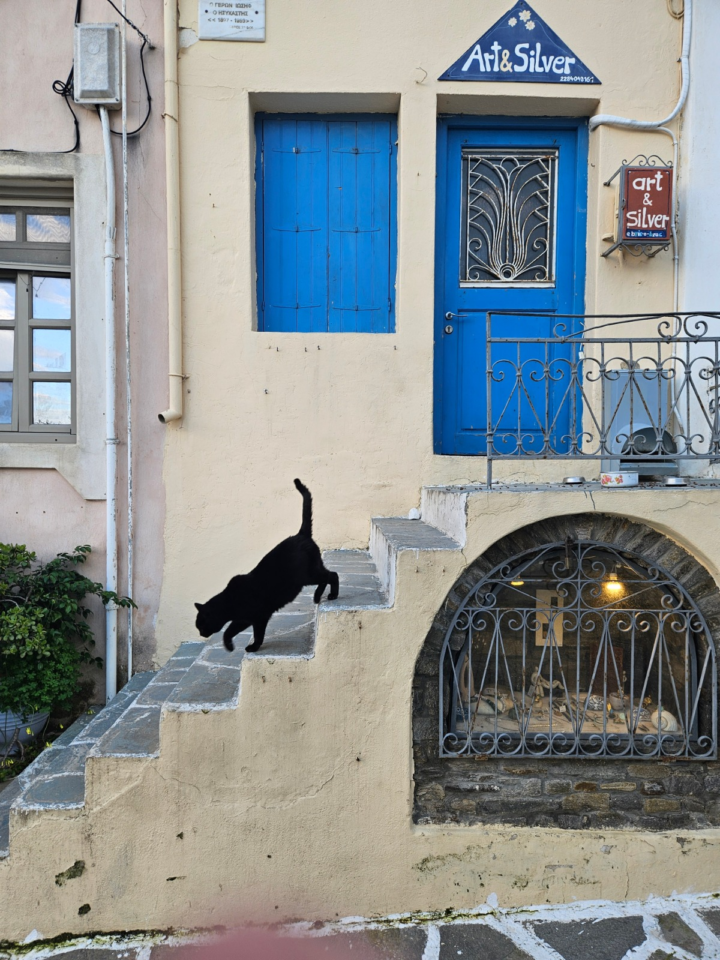
Photo Credit: Dr. Ronald Meinardus
Over the years, the original owners sold, and my parents came into possession of this dream property. We spent wonderful times there in our “Germaniko,” in small circles and large. Bonds and friendships with the local community took shape. As homeowners from afar, we belonged to a small circle of expatriates with a vibrant social life.
The idyll did not last forever. After my mother’s early death – God rest her soul – and a bout of family back-and-forth, we sold the house. Real estate often carries a powerful emotional charge. Most people feel this keenly, at the latest when it comes to a parental home.
In our case, the transfer fell in the 1990s. My initial philhellenic Sturm-und-Drang phase was behind me; with my future wife I had moved the center of my life to South Korea. It was hard to be farther from Greece and the Greeks – and Paros became a memory of beautiful, bygone times. In my mind, an idealized image of the “good old days” took hold. I did not want it disturbed.
Once the family villa had changed hands, we sought out other destinations in the alternative-rich Hellenic archipelago. For several summers we traveled from East Asia to Chios. When the long drives on that large island began to weary us, we discovered Hydra in the Saronic Gulf. That island, with its rich history, remains our place of longing to this day.
Meanwhile – we could observe this from afar – Paros continued its rise as a hotspot of Greek tourism. It was a dynamic, with all its side effects, that left me uneasy and that I had no desire to confront firsthand. For me, a visit to Greece always meant, first and foremost, the chance to exchange with Greeks. As best we could, we steered clear of tourist hubs – which ultimately led to Paros being struck from our list. This partly irrational resistance endured even after we settled permanently in Athens nearly four years ago, now in retirement.
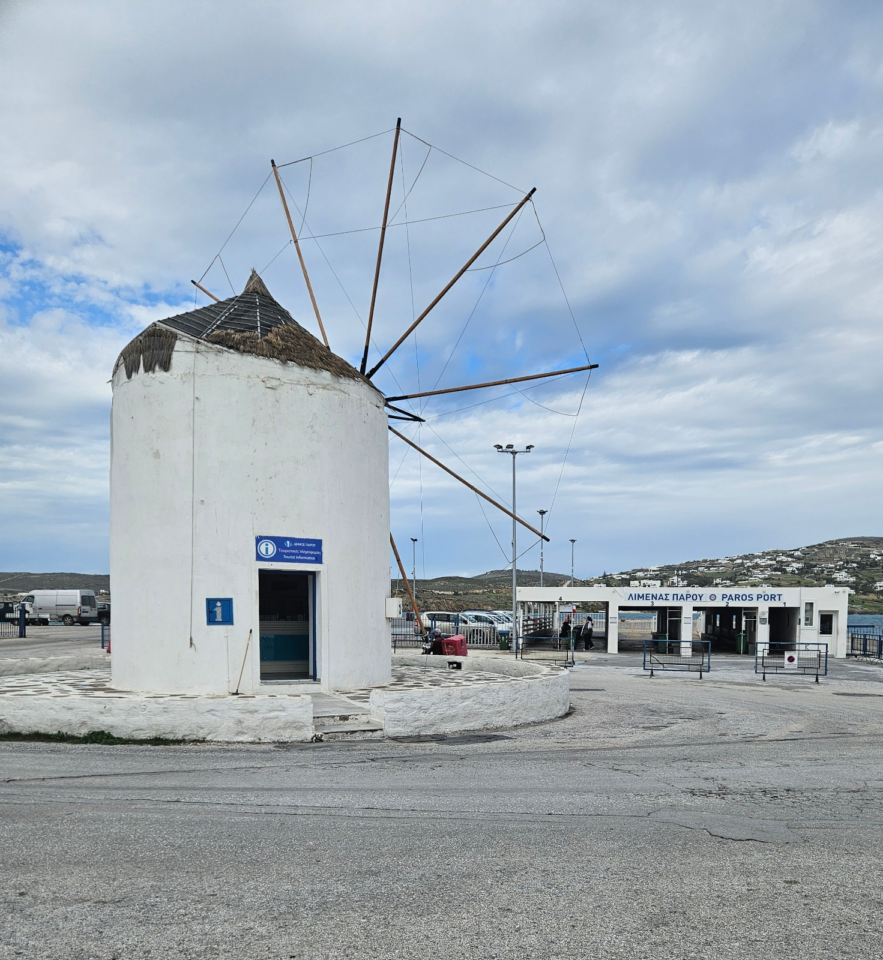
Photo Credit: Dr. Ronald Meinardus
And yet I have now ended this personal boycott and have just returned to my desk from a very beautiful trip to Paros. What follows is a kind of travelogue of this short visit – shaped by observations of the here and now and by the constant question: What was it like back then, when I last stood on the island 25 years ago?
I still owe you an answer to why I overcame – indeed, had to overcome – my abstinence from Paros. The key lies in a biographical episode involving a small property in the picturesque inland village of Lefkes. It dates – I use the term deliberately again – to my philhellenic Sturm-und-Drang years.
It was passages in Bitter Lemons by Lawrence Durrell, in which the British author vividly recounts buying a house in the Cypriot mountain village of Bellapais, that inspired me to attempt something similar on Paros. I set off on a weeks-long ramble through what were then the island’s remote settlements, which eventually led me to Lefkes – and to an old stone house on which I spotted the word “πωλείται” (“for sale”). The purchase price, from today’s perspective strikingly low, was provided by my generous mother.
In the negotiations, which concluded at the notary’s office in the island capital, an almost familial bond developed with the seller couple, marked by a hospitality and warmth straight out of a book. Since 1978, I have called a small property in the interior of Paros my own, which even then had something of a museum quality to its amenities. The lack of electricity and very rudimentary sanitary conditions did not prevent the occasional romantic moment. But the remoteness of the mountain village and the pull of the fully equipped villa by the beach in Parikia soon meant that the house in Lefkes became an occasional refuge for visitors from abroad, for whom the absence of modern comfort apparently posed no issue.
All that lies many years back. The parental villa has long since changed hands, and the dwelling in Lefkes has been quietly crumbling, largely unused. Greece’s old stone houses are solidly built; their thick walls can endure much. It was not structural damage that forced me to act, but rather the tight deadlines of the local land registry.
In the course of digitizing cadastral maps, my small, intricately tucked-away house in Lefkes came to the attention of the authorities. It was not easy to find, on short notice, a surveyor willing to earn a bit extra measuring an old farmhouse. Paros’s construction industry is accustomed to larger dimensions; priorities lie elsewhere.
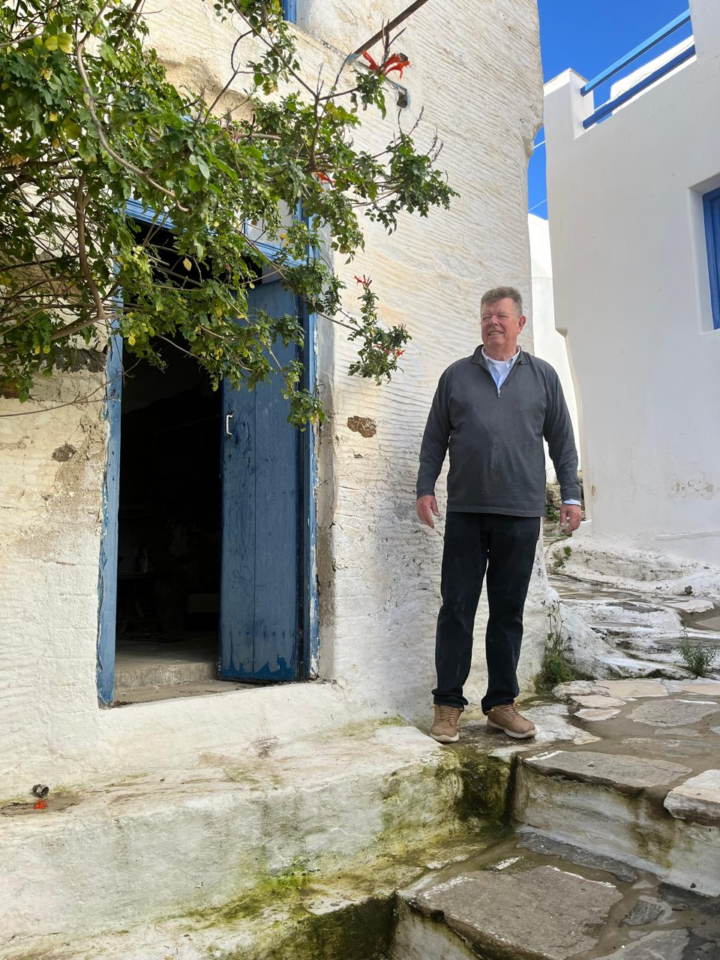
Photo Credit: Dr. Ronald Meinardus
The survey took place on a sunny morning with the help of a drone and a laser scanner. The scene had symbolic weight: two worlds colliding – the modern high-tech world and a long-vanished era without electricity or sewage. This dialectic between old and new is palpable on Paros at every turn.
For a Greek island in particular, I wish – and I am not alone in this – for a form of sustainability that respects old structures and that distinctive, indeed unique, aesthetic. In Greece there is no shortage of cautionary examples where historical substance has fallen victim to the short-term pursuit of profit.
The good news: the fears that underpinned my long abstinence from Paros have not been confirmed. That may also be because we arrived in early February – effectively at the height of the tourist off-season. Many of the darker sides of mass tourism remained hidden from us. Even so, the signs that the once sleepy island has irreversibly changed are impossible to overlook.
One might think oneself in Athens when locals complain about regular traffic jams on their island. No fewer than 30,000 rental cars are registered on Paros, I am told when I inquire at one of the many travel agencies. In addition, nearly every one of the roughly 15,000 islanders seems to keep a car outside the door – if a parking space can be found. The scenario of traffic collapse becomes acute in the summer months, when many visitors from the mainland bring their own vehicles. Everyone I spoke with lamented the traffic spinning out of control.
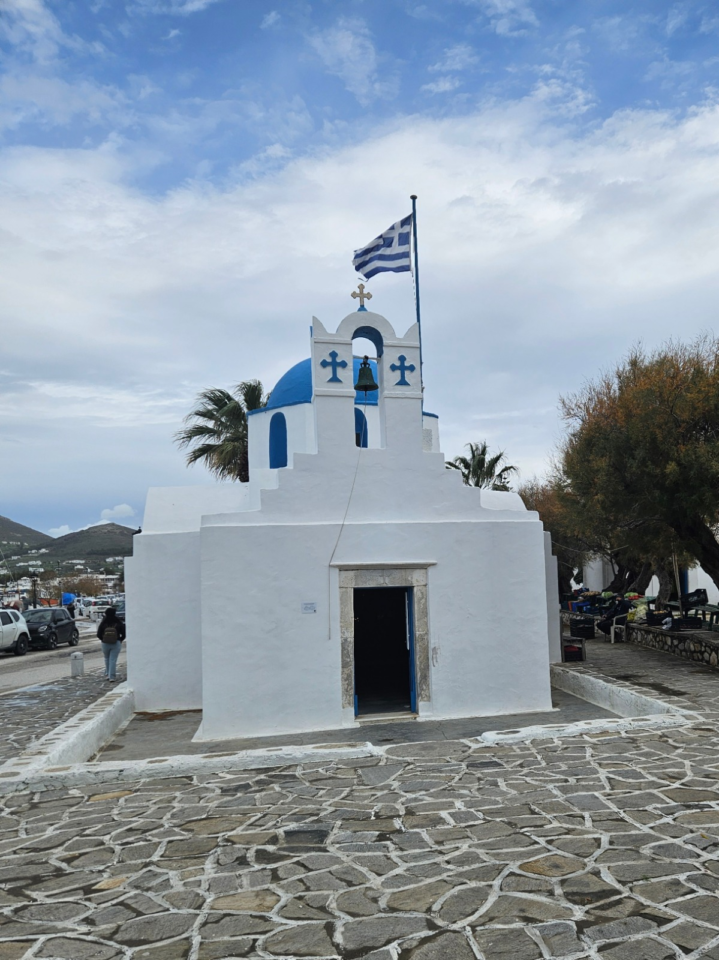
Photo Credit: Dr. Ronald Meinardus
Another point of criticism is the unrestrained building boom. Where digging and construction are not under way, one often sees a sign reading “For Sale.” Paros has long since arrived in the globalized economy – with all its positive and negative side effects.
Like Greece as a whole, the island races from one visitor record to the next. Most recently, more than 200,000 tourists came to meet a population of about 15,000 islanders. Locals can no longer manage this influx without outside help. Now, in winter, it is mainly Albanians and Egyptians who fill the few cafés that remain open. On Paros, one hears, more than 3,000 workers from Albania alone labor on the many construction sites, supported by young men from Egypt; some have work papers, others work off the books.
The surveyor who measured my small house in Lefkes speaks of around 2,000 officially approved construction projects. Some properties lie in the absolute luxury segment and will, sooner or later, reach the international real-estate market for sums in the millions. While many on Paros welcome the continuing rain of money, others feel the bustle has gone too far.
“Half the island has been sold to investors and speculators,” complains the owner of a café in Piso Livadi, the only one to keep his shop open even in the slow season. He criticizes many locals who quickly cash in and sell house and land. I might, perhaps, soon belong to that group – should I, after my long-overdue visit, decide to sell my small house in Lefkes to the highest bidder. So that someone else – after due renovation – may take pleasure in it.
As I did, many, many years ago.
Dr. Ronald Meinardus is a Senior Research Fellow at the Hellenic Foundation for European and Foreign Policy (ELIAMEP) and a self-declared philhellene who spent many of his formative years in Greece and has now returned to Athens permanently.