
As crossings from Libya reshape Greece’s migration map, Athens and four European partners are advancing a controversial plan that could send rejected asylum seekers to a return center in East Africa beginning in 2027.
For much of the past decade, Greece’s migration story was associated with the eastern Aegean — Lesvos, Chios, Samos and the short but dangerous sea crossing from Turkey.
Increasingly, the map is shifting south.
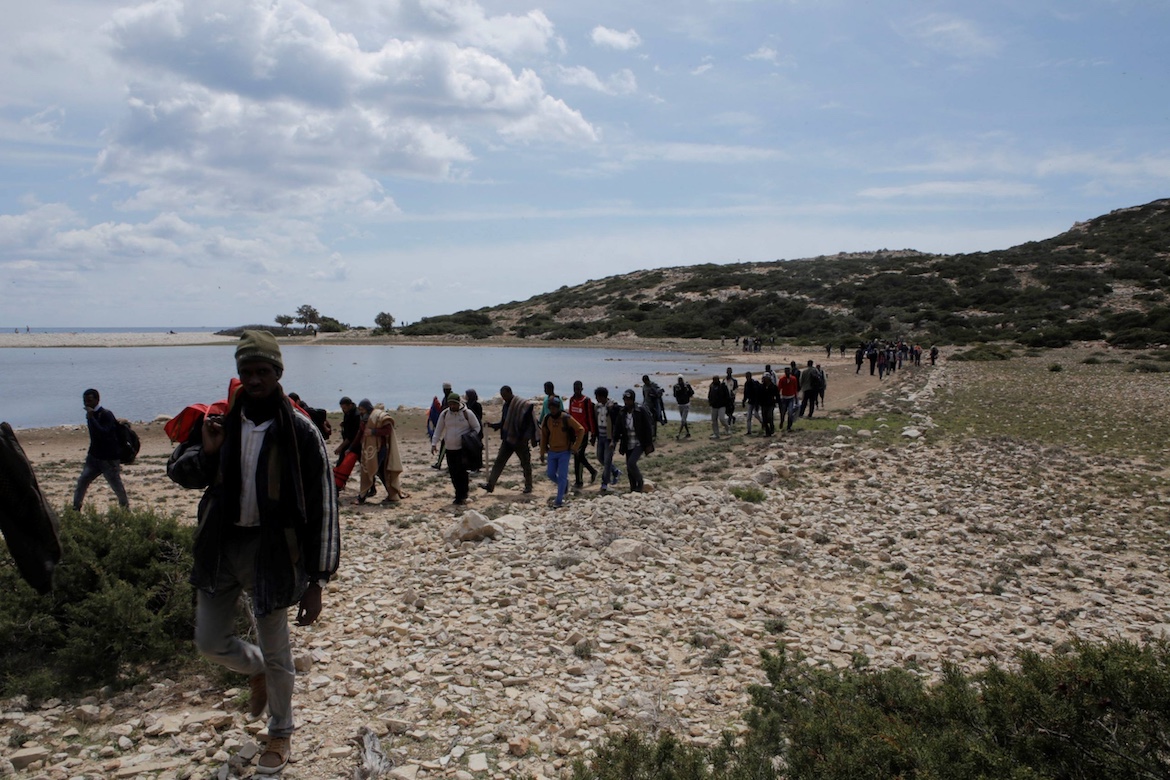
Crete and tiny Gavdos, sitting at Europe’s southern edge opposite the coast of Libya, have emerged as a major new entry point into Greece. Roughly 20,000 people reached the two islands along the so-called southern corridor in 2025, a dramatic increase over the previous year. During the first six months of 2026 alone, another 8,552 arrivals were recorded on Crete and Gavdos. By early August, the number reaching Crete from Libya this year had risen to approximately 10,000 — roughly half of all arrivals in Greece.
And the boats are still coming. Greek authorities rescued 240 people south of Crete on August 12, followed two days later by another 134 people aboard two boats that had crossed from North Africa.
The emerging route — generally beginning around Tobruk in eastern Libya — is significantly longer than the familiar Turkey-to-Aegean crossings. It requires migrants to travel hundreds of kilometers across open Mediterranean water, often aboard overcrowded and unseaworthy vessels. The International Organization for Migration reported this week that deaths on Mediterranean migration routes have risen sharply in 2026, with fatalities on the Eastern Mediterranean route more than tripling compared with the previous year.
It is against this backdrop that PBS NewsHour correspondent Malcolm Brabant traveled to Athens for a report examining Greece’s increasingly aggressive effort to deter irregular migration — and a new European strategy that could eventually send thousands of rejected asylum seekers far outside Europe.
WATCH: PBS NewsHour — “Greece toughens stance on illegal migration with new deportation plan”
The PBS report also highlights a newer dimension of the migration battle: social media.
Videos filmed aboard boats traveling from Libya to Crete increasingly circulate online, sometimes portraying the crossing as a successful journey into Europe while offering little indication of the dangers involved. Dimitris Kairidis, Greece’s former migration minister and currently a parliamentary spokesman for the governing New Democracy party, told PBS that smugglers themselves are among those exploiting social media to advertise routes into Europe.
For Greece, however, stopping departures is only one part of the strategy.
The more consequential change concerns what happens after people reach Europe and are ultimately determined not to qualify for protection.
From Crete to Uganda?
Greece is working with Germany, Austria, Denmark and the Netherlands on plans for what European policymakers call a “return hub” outside the European Union.
And Uganda has now emerged as the leading candidate.
According to reporting this week by Kathimerini, citing diplomatic sources, negotiations with Uganda have reached an advanced stage. Migration ministers from the five countries are scheduled to meet in Copenhagen on September 4 to assess progress, while technical teams are expected to continue discussions in Africa. Rwanda has reportedly been retained as an alternative should an agreement with Uganda fail.
The negotiations are being conducted by the five national governments rather than by the European Commission, an EU spokesman confirmed this week. No final agreement with Uganda has yet been signed.
The proposed facility could initially accommodate between 5,000 and 10,000 people whose asylum applications have already been rejected in European countries, according to the Kathimerini report. Uganda would receive financial compensation under the plan, and supporters of the concept believe relocation to East Africa could encourage more people to return voluntarily to their countries of origin rather than remain there.
The policy is built around that separation.
A return hub is not, under the EU framework, intended to be a general offshore destination for everyone arriving irregularly in Greece. It is designed for people who have gone through the relevant procedures and are subject to a return decision because they no longer have a legal right to remain in the European Union.
The concept became legally possible following a major shift in European migration policy this summer. The European Parliament and Council reached agreement in June on a new common system for returns allowing member states, under certain conditions, to establish facilities in third countries outside the EU. Agreements must comply with international human rights standards and the prohibition against returning people to places where they face persecution or serious harm.
Greece moved quickly. Parliament approved national legislation in June designed to accelerate the removal of rejected asylum seekers and provide the legal framework for participation in external return hubs.
Prime Minister Kyriakos Mitsotakis has made clear that the tougher approach is deliberate.
Speaking in June, he said Greece would make irregular entry more difficult while continuing to accept those legally entitled to protection.
“If you’re not entitled asylum, I will send you back,” Mitsotakis said, while drawing a distinction between irregular migration and the legal migration Greece increasingly needs to fill shortages in agriculture, manufacturing and services.
The government argues that effective returns are essential if Europe wants to undermine the business model of smugglers and convince would-be migrants that paying thousands of dollars for a dangerous Mediterranean crossing does not guarantee permanent residence in Europe.
The other side of the debate
The plan has also triggered serious concerns from European human rights authorities.
In July, Council of Europe Commissioner for Human Rights Michael O’Flaherty wrote directly to the governments of Greece, Germany, Austria, Denmark and the Netherlands, warning that any return-hub arrangement must include binding human rights protections, independent monitoring, public scrutiny and mechanisms capable of suspending operations when violations occur.
That debate is reflected in the PBS report.
Alongside Greek officials arguing for stronger deterrence, Brabant interviews representatives of the Greek Council for Refugees, who contend that increasingly restrictive border policies risk weakening safeguards built into European asylum law.
The report also introduces viewers to people who complicate any attempt to reduce migration to numbers or policy slogans: a South Sudanese refugee granted asylum in Greece after fleeing conflict, and a Sierra Leonean mother who was also granted protection and wants to build her life in Greece.
Their stories underscore the distinction at the center of the government’s own argument: between those Europe determines need international protection and those whose claims have been rejected.
Finding a system capable of making that distinction fairly — and then actually enforcing the decisions — has bedeviled European governments for years.
In the first quarter of 2026, EU countries ordered more than 108,000 non-EU nationals to leave, while approximately 34,500 were actually returned to countries outside the bloc. The gap between return decisions and actual departures is one of the principal arguments European governments make for rewriting the system.
Crete at the center of a changing European policy
For Greece, this is no longer primarily an Aegean story.
Eastern Libya has created a new corridor pointing directly toward Crete and Gavdos. European border agency Frontex has increased surveillance of the region, Greece has expanded cooperation with Libyan authorities, and Athens is simultaneously trying to create consequences for migrants who successfully complete the crossing but ultimately have no legal right to remain.
The Uganda proposal represents the furthest extension yet of that strategy.
If the five-country agreement moves forward, the first return hub could begin operating in 2027. Greece will hold the rotating presidency of the European Union beginning in July of that year, potentially putting Athens at the center of one of Europe’s most consequential — and contentious — experiments in migration policy.
Whether offshore returns actually deter the boats remains an unanswered question.
But one change is already unmistakable: after years in which Lesvos and the eastern Aegean symbolized Europe’s migration challenge, Crete has become one of its newest front lines.