

Recent campaigns by Sea Shepherd in Northern Greece have shed light on the extent of illegal octopus fishing. In a 41-day operation this summer across the Thracian Sea and Thermaic Gulf, the crew of the vessel Sea Eagle retrieved 34,546 plastic traps and 288 kilometers of fishing line. This effort led to the rescue and release of approximately 1,500 octopuses. In September of 2024 in the Thracian Sea, Greece’s largest octopus ecosystem, the collection effort yielded over 6,500 traps and 52,000 meters of rope, with 571 octopuses freed. It is estimated that more than 500,000 illegal traps currently litter the seabed in Northern Greece alone.
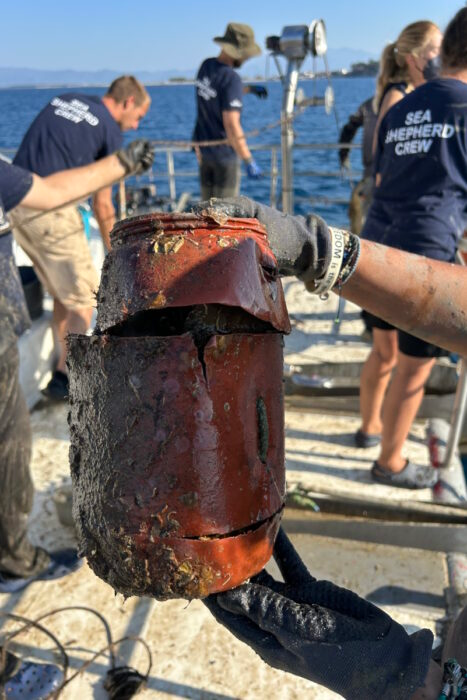
Octopus Traps | Image Credit: Sea Shepherd
“The numbers are absolutely staggering,” Alex Cornelissen, CEO of Sea Shepherd, told Reuters. “If you want to preserve the octopus, then you have to do something about it”.
Greek law prohibits the use of octopus traps from July through September to protect the species during its crucial reproductive season. However, many operators flout the law, leaving traps in the water year-round.
This illegal fishing practice is devastating for two primary reasons. First, it targets octopuses during their vulnerable reproductive period — secondly, it creates massive plastic pollution in the sea.
Greek regulations cap the number of octopus traps at 1,500 per vessel, but some boats have been found to use as many as 20,000. To avoid detection, these illegal traps are almost never marked with the owner’s name or license number as required by law, making enforcement of these numbers nearly impossible.
The octopus traps themselves are also a significant environmental hazard. Often fashioned from cheap plastic containers, they are left to degrade in the sea. “The majority of the traps we collected were so damaged that they shattered in our hands,” Sea Shepherd reported, highlighting how these traps break down into harmful microplastics that enter the food chain.
“We want to drink our ouzo by the sea,” said Valia Stefanoudaki, Campaigns Manager for Sea Shepherd Greece. “But the fact that the sea is emptying doesn’t even cross our minds. It’s a chain, from the smallest creatures to the largest. When the chain breaks, everything ends.”
Speaking to the Pappas Post, Stefanoudaki also added that “for the octopus population to recover, the Greek government should ban these plastic traps as fishing gear, and ban the fishing of octopus from 1st of July until the end of September during the octopus’ reproductive season. The Greek government should also not hand out fishing licenses using this method, during the octopus’ critical reproduction period, and to a distance of up to 6 miles out to international waters.”
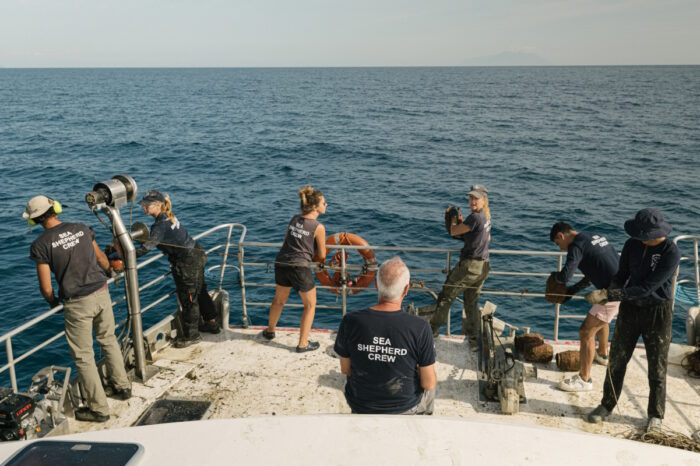
Gathering up octopus traps | Image Credit: Sea Shepherd
Sea Shepherd’s campaigns have been carried out in close cooperation with local authorities, including the Port Authorities of Porto Lagos, Alexandroupolis, Kavala, Thessaloniki, the administrative region of Eastern Macedonia and Thrace, as well as the administrative region of Central Macedonia. Sea Shepherd has also worked with Greek university fisheries departments as well as the Pan-Hellenic Society of Technologists Ichthyologists.
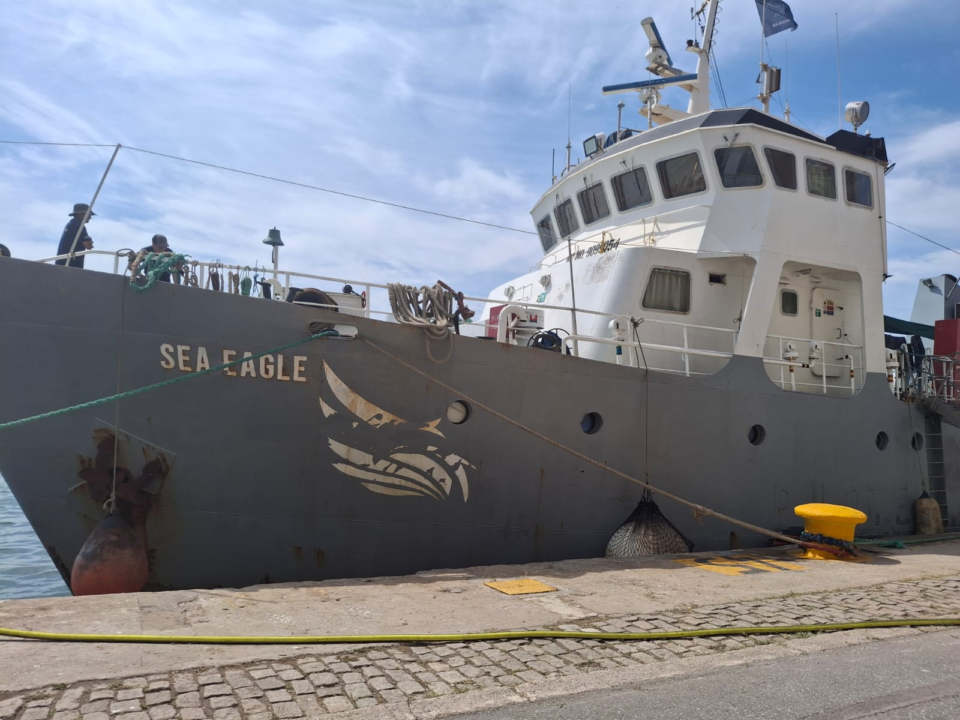
The Sea Eagle | Image Credit: Sea Shepherd
Sea Shepherd plans to continue its surveillance of Greek seas over the winter, using drones to detect and report illegal fishing activities. The organization is also sharing its data with the Hellenic Ministry of Rural Development and Food, to advocate for a complete ban on these harmful plastic traps.