
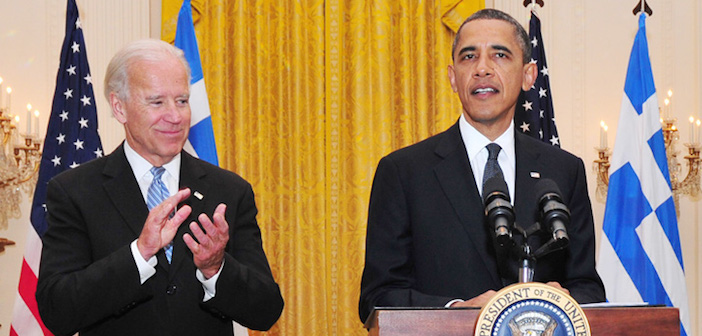
President Obama said Tuesday that he was trying to convince European leaders to compromise on a deal to keep Greece in the eurozone, even as his government was bracing for the possible consequences of a once unimaginable divorce.
“It is an issue of substantial concern,” Mr. Obama said just hours before Greece missed a debt payment to the International Monetary Fund of 1.5 billion euros, or about $1.72 billion. “I’ve spoken to my European counterparts, encouraging them to find a path towards a resolution.”
Several American newspapers, economists and activists– including The Boston Globe have publicly urged the Obama Administration to give Greece support, arguing the strategic importance of the partnership.
At their National Convention in San Francisco, the American Hellenic Progressive Educational Association (AHEPA) issued a statement calling on the Obama Administration to “step up its engagement” on the matter.
The Greek Orthodox Archdiocese of America has been quiet on the matter, issuing a statement only in the Greek language on its official website that the Archbishop was monitoring the developments closely and he called for calm and prudence on the part of the Greek people. The Archbishop shares a close relationship with President Obama.
Obama’s comments reflected escalating efforts by his administration to impress upon European leaders the need to relax some of their demands on Greece in the interest of finding a resolution.
Treasury Secretary Jacob J. Lew spoke by telephone Tuesday with the finance ministers of three important eurozone countries — the Netherlands, Italy and France — as part of the administration’s push to soften Europe’s stance.
Mr. Lew emphasized the importance of “pragmatic compromise” to keep Greece in the monetary union, according to an account released by the Treasury Department. While acknowledging that Greece needed to adopt further reforms — a message Mr. Lew has conveyed to the Greek prime minister, Alexis Tsipras, in a series of recent phone calls — he called on the Europeans to provide Greece with “a path to debt sustainability.”
He also dispatched Ramin Toloui, a top Treasury Department international finance official, to Brussels, Paris and Berlin to follow the talks.
The crisis in Greece is “something that we take seriously, but it’s not something that I think should prompt overreactions,” the president said at the White House during a news conference with President Dilma Rousseff of Brazil.
According to The New York Times, which is following the matter closely and has reported extensively on the Greek debt crisis, “The muted language masked mounting uneasiness at the White House over the situation in Greece,” where the government has shuttered banks and limited A.T.M. withdrawals to preserve dwindling supplies of currency. Greece has scheduled a national referendum on Sunday over Europe’s debt repayment demands.
The governing Syriza party has called for a national referendum and is asking the Greek people to reject those demands, insisting that it could then negotiate a more favorable deal. European leaders have repeatedly warned that a “No” vote would put Greece on a path toward leaving the eurozone.
The concerns of American officials extend beyond the health of the European economy and the stability of global financial markets. Greece is a member of NATO, and its economic estrangement from other members of the alliance, which operates by consensus, has the potential to complicate American foreign policy at a time of rising tensions with Russia and turmoil in the Middle East and advances westward of ISIS.
The White House has made a point of noting in recent days that Greek stability is in the United States’ national security interest as well as in its economic interest. In addition to strong commercial ties, the United States maintains a strategic naval base at Souda Bay in Crete, the location where much of the refueling and servicing of the Mediterranean fleet takes place and critically important to US efforts in the region, as evidenced by Souda’s role in the Iraq War.
“They’re worried, but they’re limited in what they can or should do,” said Doug Rediker, a visiting fellow at the Peterson Institute for International Economics and a former appointee of Mr. Obama’s to the I.M.F.’s executive board.
“They have gone out of their way, both the White House and Treasury, to try and explain to all the European parties why coming to a deal is better than not coming to a deal, but they’ve been respectful of the fact that it is largely a European issue, and the vast majority of the funds that are at risk are European funds.”
Mr. Lew has had more than 60 phone calls or meetings with European officials on the matter over the past six months, and both he and the president have raised it frequently with their foreign counterparts.
The United States has consistently argued that both Greece and its creditors must make sacrifices to preserve the currency union. Mr. Obama has backed European calls for Greece to expand economic reforms, including further cuts in public spending, but he warned in February that “you cannot keep on squeezing countries that are in the midst of depression.”
The president has stepped up his efforts this week to prevent the debt talks from derailing, making a round of calls to European leaders to encourage them to come to terms with Greece. On Sunday, the president phoned Chancellor Angela Merkel of Germany, a critical figure in the negotiations, and the two “agreed that it was critically important to make every effort to return to a path that will allow Greece to resume reforms and growth within the eurozone,” the White House said in an account of the call.
On Monday, Mr. Obama made the same points with President François Hollande of France and Prime Minister David Cameron of Britain.
The Obama Administration has already stretched its legal authority to help Greece. A 2010 law requires the United States to oppose I.M.F. loans unless the administration concludes that the loan is likely to be repaid.
Senator John Cornyn, Republican of Texas, offered Greece as his example when he inserted the provision into the 2010 Dodd-Frank Act on Wall Street regulation, and he has argued that the United States violated the law by supporting an I.M.F. loan to Greece in 2012.
The United States is the largest shareholder in the I.M.F., contributing 18 percent of funding, and it exercises an effective veto over major policy decisions. More than 30 countries have fallen into protracted arrears with the fund during its history, and most have eventually repaid.
“While Greece is currently in arrears,” a Treasury spokesman said, “we expect the I.M.F. will ultimately be paid in full.”