
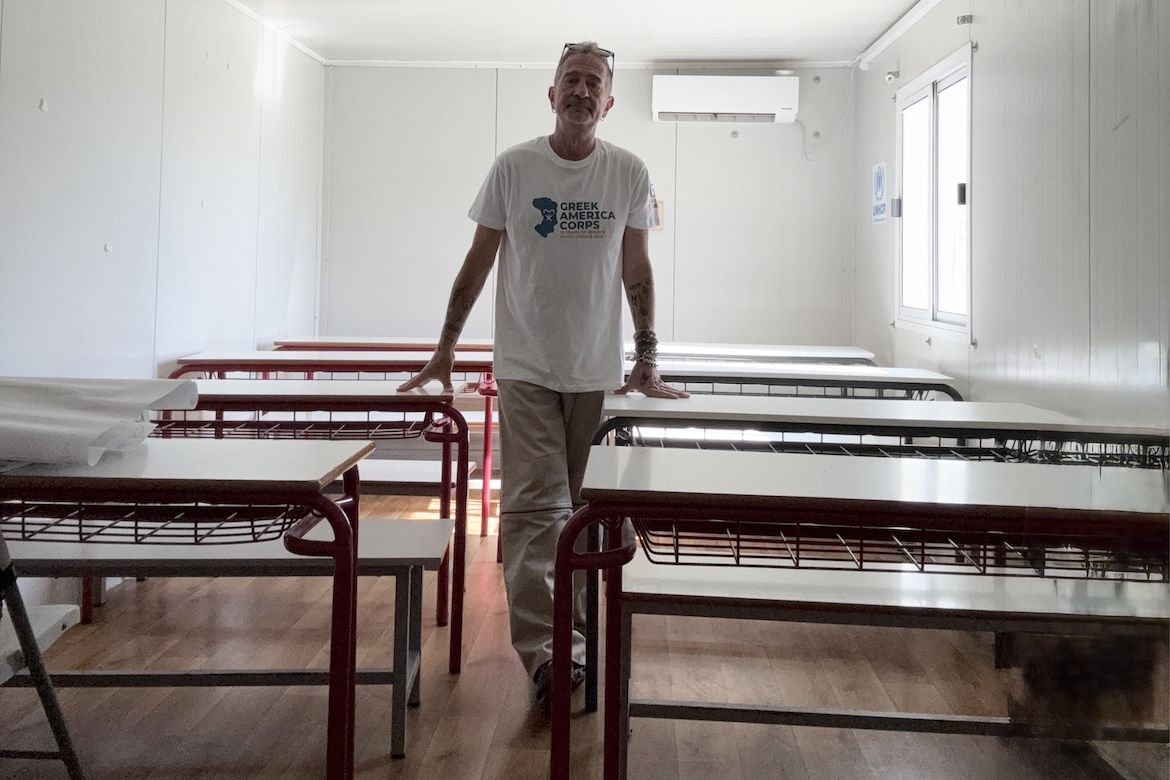
I recently found myself standing inside a classroom on the island of Chios, preparing to leave after another summer of service.
The children were gone, but traces of them remained everywhere—in the garden they had planted, the walls our volunteers helped paint and the spaces that had briefly filled with lessons, games and laughter.
These were children who had arrived in Greece from countries torn apart by war. They had crossed borders and lived through uncertainty no child should be forced to understand. Inside that classroom, however, they were given the chance to do something beautifully ordinary: learn, play and simply be children.
It was also where I found myself thinking about what it means to be Greek.
For much of the diaspora, our connection to Greece is expressed through familiar things. We return to ancestral villages. We learn the dances. We cook the recipes our grandparents carried across the ocean. We celebrate name days, attend festivals and speak—sometimes fluently, sometimes imperfectly—the language handed down to us.
All of that matters.
But after ten years of bringing volunteers to Greece through the Greek America Foundation’s summer volunteer program Greek America Corps, I have come to believe that being Greek and proudly expressing our Greekness must eventually ask something of us.
It cannot exist only as nostalgia.
Over the past decade, young people from across the United States and Canada have traveled to Greece to serve refugee children, forgotten senior citizens, children living in institutions, homeless people and families struggling to put food on the table.
They have collected food from open-air markets, prepared meals, cleaned beaches, planted trees, cared for animals, restored neglected spaces and painted schoolyards.
Many arrived in Greece carrying the usual stories about where their grandparents were born and what island their families came from. But they left with a different understanding of their relationship to the country.
Greece was no longer simply a place they inherited.
It became a place toward which they felt responsibility.
That distinction matters, particularly at a time when Greek identity abroad can so easily become something performative— a flag in a social media profile, an annual festival, a photograph beneath the Acropolis or an argument about who is “Greek enough.”
There is nothing wrong with celebrating who we are. But identity becomes more meaningful when it moves beyond display and becomes action.
The Greek word philotimo is often treated as though it possesses some magical definition that cannot be translated. We invoke it proudly, print it on shirts and describe it as something uniquely embedded in the Greek soul.
But philotimo is not proven by how often we say the word. Or how many times we post about it on our social media platforms.
It is proven by whether we live it.
It is bringing food to someone who is hungry. Sitting beside an elderly person who feels forgotten. Entering an unfamiliar community without judgment and asking what is needed. It is offering your hands, your time and your presence without requiring that the person receiving them look like you, pray like you or share your history.
Hope has no age or religion. Hunger has no skin color.
That understanding has guided ten years of work. Nearly $600,000 in scholarships has helped approximately 150 young people travel to Greece and serve communities in need. But the significance of those numbers extends beyond the projects completed or the people reached.
The volunteers were changed, too.
Many returned home with a deeper understanding of leadership and a broader definition of community. Some continued serving in their own cities. Others returned to Greece year after year—not only for beaches, family reunions and summer vacations, but because they had formed relationships with people and places that called them back.
That may be one of the most important things we can offer the next generation of the diaspora.
We spend a great deal of time worrying about whether young Greek Americans will preserve their identity. Will they speak Greek? Will they join our organizations? Will they remain connected to the Church? Will they care about the villages their ancestors left behind?
These are valid concerns. But perhaps we should also ask whether we are giving them a Greek identity worth carrying.
Young people do not need another lecture about preserving the past. They need opportunities to give that inheritance meaning in the present.
They need to understand that being Greek can mean serving humanity. That loving Greece can include standing beside the people living within it today—regardless of where those people were born. That heritage is not weakened by compassion for others; it is strengthened by it.
The Greek America Foundation recently marked the tenth anniversary of this work, and naturally, an anniversary invites us to look back.
But standing in that empty classroom in Chios, I was thinking less about what had already been accomplished and more about what the experience had taught us.
Showing up once can be an act of generosity.
Showing up year after year becomes a promise.
And perhaps that is the responsibility carried within heritage: not simply to remember where we came from, but to decide what we will do with what we inherited.
Our grandparents crossed oceans and built new lives. They gave us stories, traditions and a sense of belonging that survived distance and generations.
What we do with that inheritance is now up to us.
We love to speak about philoxenia, philanthropia and philotimo.
We hold these ideals up as evidence of something beautiful and enduring within Greek culture.
But these words mean very little if we only use them to describe ourselves.
They must be lived.
Being Greek is not only about where our families began, the traditions we preserve or the ideals we proudly claim as our own.
It is about living the very ideals we are so proud to say define us.
We’re already busy planning 2027 volunteer programs. We’re strengthening ties with existing partner organizations on the ground in Greece. We’re exploring new partner relationships. We’re building our existing volunteer alumni network because we’ve learned that our “repeats” are the best volunteers.
Furthermore, we’re also exploring the possibility f adult volunteer programs, even family programs, allowing more people the opportunity to come to greece, spend spme time sharing their talents and time with people in need, while simultaneously having an opportunity to combine the experience with a vacation.
We’re open to new ideas. We need funding support, as well. I’m an email away, if you are interested in exploring any of these options with me.