
It’s a strange and difficult time for people of faith throughout the world— no matter which faith tradition they might follow— who are looking for clarity, strength and renewal from their spiritual leaders.
As Orthodox Christians, we are unable to attend church services and be with our families, our koumbari, the aunts and uncles of our children. We can’t break bread together at after-church luncheons, nor bake together in preparation for our Spring and Summer festivals. To many, the loss of this community has been the worst part of the pandemic.
Of course, to others, not being able to receive the most important of sacraments— Holy Communion— that we believe is medicine that heals, is the worst of ironies, especially at this time of mass sickness.
People are struggling— and during this struggle they aren’t even able receive the hopeful, helpful and positive messages from their priests beyond a computer screen.
The most important week of renewal for Orthodox Christians— Holy Week— found us locked in our homes staring at iPad screens while priests chanted in empty churches before us.
I cried to myself on the eve of Holy Thursday, watching Jesus Christ on the wooden cross while the priest online chanted “Today is hung upon the Tree…” while he proceeded to make his way around an empty church.
Fortunately, many spiritual leaders have used this opportunity to put the crisis into a different perspective. A positive, and hopeful one and one we can all learn from.
Bishop Demetrios of Mokissos shared a series of hopeful and relevant video greetings including a Paschal message of hope and renewal.
Archbishop Nikitas of Great Britain took a completely different approach and offered his followers a profound opportunity to look at the glass half full and to ponder what this pandemic has given us, rather than what it’s taken away.
Archbishop Elpidophoros of America took a bold step and for the first time in the Church’s history, illuminated millions of people around the world with the Άγιο Φως— the Holy Light of the Resurrection— digitally.
These— and many other spiritual fathers and spiritual leaders— used the resources they had at their disposal to share positive, encouraging, hopeful messages with a flock thirsty for spiritual nourishment and answers to sometimes unanswerable questions.
They provided solutions and work-arounds when asked by their faithful how they will worship, or how they will inspire their children to stay connected to God when the entire world is being told to stay physically disconnected.
Yet in one Greek Orthodox parish in suburban Chicago, the priest had a different message to his faithful.
On Good Friday after the services of the “Apokathilosis,” when Jesus is taken down off the cross and placed into the Kouvouklion, in preparation for the “funeral procession” and the singing of the Hymns of Praise that will take place later that day— this priest didn’t offer a message of hope, or advice to his faithful on how they can be a part of Christ’s Passion while at home.
He didn’t offer a special word to the children, who were struggling to understand why they won’t be able to walk under the Epitaphio this year, or explain to the little girls why they won’t be able to put on their white dresses and decorate Christ’s tomb with flowers this year.
Instead, he blamed gays, atheists and abortions for the Coronavirus.
To be fair, his medieval, vile words were much more eloquent than my synopsis above, but if you listen to the clip (provided below), you’ll understand exactly who’s to blame for this global health crisis, according to this priest who is amongst us and preaching in the year 2020.
The video was taken down from the Church’s website and some will wonder why I have chosen to share publish his angry, vile words.
My answer is simple: Agape.
This year, New York Life released a commercial explaining the different types of love described by classical Greek language – starting with philía/φιλία, moving to storgē/στοργή, and then to érōs/έρως.
But the commercial concludes that it is the fourth kind of love that is “the most admirable”; it is “love as an action…it takes courage, sacrifice, strength.” This kind of love is agápē/αγάπη.
More than ever, Agape is needed. And I am heartened to see so many express this most admirable kind of love through action.
Archbishop Elpidophoros and Archbishop Nikitas and Bishop Demetrios expressed it with their actions, as I mentioned above.
First responders who risk their own lives – and some have sacrificed theirs – and the lives of their family members to take care of us. Restauranteurs who face an existential threat but still donate food. Random acts of kindness performed by people from all walks of life.
But we have seen the flip side as well. A young African American executed in broad daylight for daring to jog in the street. People flippantly commenting on social media about the number of lives they would be willing to sacrifice – one even declaring that his mother was willing to put her life at risk – to end “stay at home orders”. A proliferation of hate-inspiring conspiracy theories. This is the anti-agape movement.
So, it was more than discouraging that on Good Friday, as we should have been in awe at the ultimate expression of agape – as Jesus declares in John 3:16: “For God so loved the world that He gave His only begotten Son, that whoever believes in Him should not perish but have everlasting life” – that a Greek Orthodox priest resorted to hate.
This priest is articulate and sounds calm and humble, but his words were clear. He did not describe the God of agape, but one of vengeance and hate. He ignores not only John 3:16, but John 3:17 as well: “For God did not send His Son into the world to condemn the world, but that the world through Him might be saved.”
Whatever the inspiration for this priest’s comments were, they certainly did not come from what we hear during Holy Week. Listen to his remarks. Does he quote Jesus? Does he quote the teachings of the Orthodox Church? No. He quotes some peripheral religious zealot from outside our Church and community.
In the spirit of Pascha and in agape, we should be willing to forgive this priest for promoting such hate. But he hasn’t asked for such forgiveness. He just took the video evidence of his transgression down, thinking that no one would see it again.
Our Church – both as an institution and as the collective body of the faithful – faces unprecedented challenges. To overcome these challenges we need faith, not fundamentalism. We need to look to the words of Christ. We need agape.
This is an unedited clip from the priest’s sermon.
This is the complete service. The sermon is at the end.
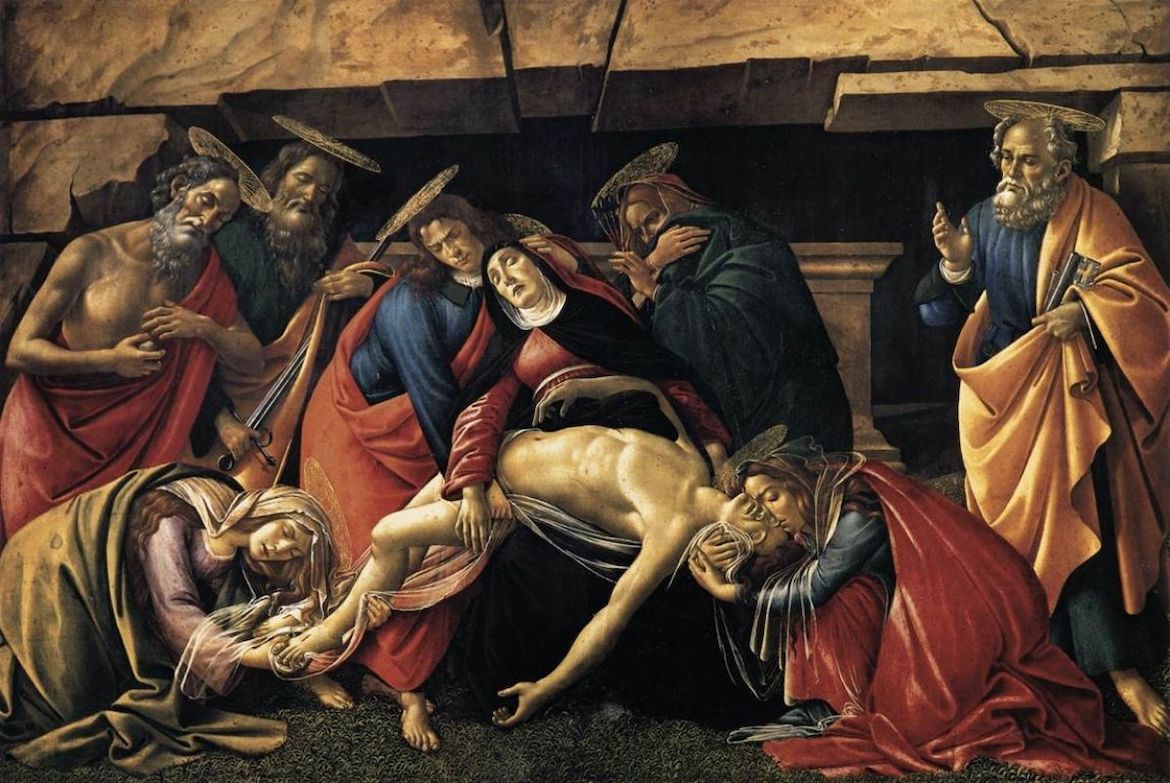
Note: The featured image is the Lamentation over the Dead Christ, a painting by the Italian Renaissance master Sandro Botticelli and captures the essence of the agape Jesus Christ’s followers had for him as they take him down off the cross and place him in the tomb.