
Apparently there are rules about touching a queen.
You do not grab a queen. You do not pat a queen or even touch her shoulder gently. You do not pull a queen into your emotional orbit like she is your cousin at a Greek wedding who just arrived late and needs to be kissed on both cheeks before being handed a plate of food.
British protocol is very clear about these things. Wait your turn. Keep proper distance. Shake hands only if invited. Maintain dignity. Preserve ceremony. Try not to behave as if you were raised by people who eat from the same plate and sound like they are in a heated argument even though it is just a quiet conversation.
That may be British protocol. And then there is Greek protocol.
Touch the person. Feed the person. Feed them more, even if they say no. Ask about their mother. Ask what church they go to and what part of Greece their grandmother was from. Pry into their personal life, even though you just met moments earlier. Cry a little. Hug before leaving. Hug again because the first hug was just the opening hug.
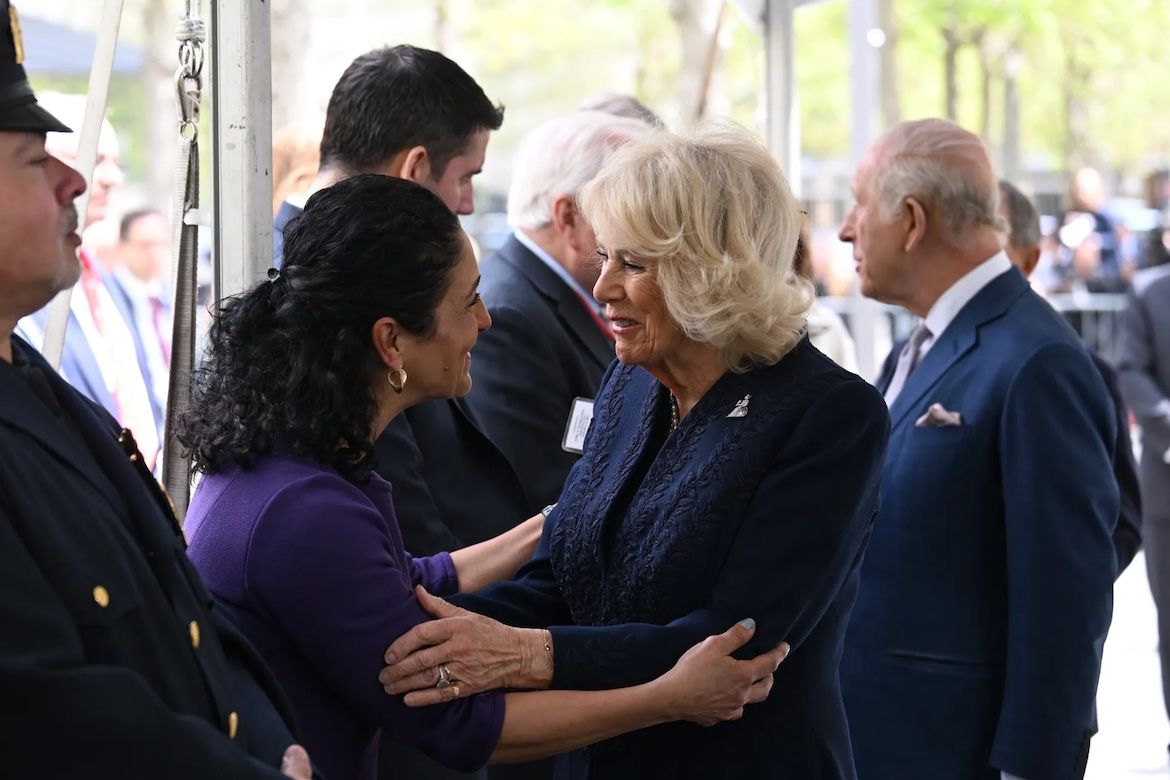
Speaking of hugging… This is exactly how Anthoula Katsimatides, a Greek woman from New York City — Astoria, Queens, to be exact — found herself making headlines around the world for doing what Greeks have been doing since the beginning of time: touching another human being because the feeling in the room demanded it.
The scene unfolded during the visit of King Charles and Queen Camilla to the 9/11 Memorial in New York City. Anthoula was there as the sister of John Katsimatides, who was killed in the North Tower on September 11. She showed Queen Camilla his photograph. They spoke. The Queen listened. And somewhere between royal formality and human grief, Anthoula asked if she could hug her.
The Queen said yes. Two women hugged. Two distant world came together as one during a single moment in time.
Cue the royal observers and media, who gasped as if centuries of royal protocol had been shattered by a single Queens-born embrace.
In Britain, commentators on television morning shows bantered about a “breach of etiquette” with the same gravity normally reserved for war, famine or someone putting ketchup on a scone.
Because hugging royalty is not exactly an everyday occurrence. It has happened before, of course, and every time it does, the British press reacts as if someone has attempted to walk out of the British Museum with the Parthenon Marbles.
There was Michelle Obama’s now-famous 2009 moment, when America’s First Lady put her arm around Queen Elizabeth II and caused a minor constitutional weather event. The Queen, for the record, returned the gesture, which should have ended the matter. But where would British television and the tabloids be without three days of experts discussing a hug? And there was also the much-shared story of a young orphan in Africa who embraced Queen Elizabeth in a spontaneous moment of affection.
These were among the rare moments in recent memory when someone dared to hug a British queen and lived to become a headline.
And now, there is Anthoula Katsimatides. Leave it to a Greek woman from Queens to enter the royal-hug archives.
Of course it was a Greek woman from Queens.
Not because Greeks are rude. Not because New York City’s often misunderstood borough of Queens has declared independence from polite society, though frankly, it has always operated with its own foreign policy.
But because Greeks are physically incapable of processing emotion from a safe distance. We touch arms. We kiss cheeks. We grab faces. We hug waiters, priests, cousins, strangers and, apparently, every now and then, queens.
This is not a lack of manners. It is who we are.
In one culture, dignity lives in restraint.
In ours, dignity often lives in embrace.
For Greeks, affection is not a private matter. It is practically infrastructure. We hug hello. We hug goodbye. We hug in the middle of conversations for no clear logistical reason. We hug people we have just met because their grandmother came from the same village as someone our uncle once knew in 1968.
Some might argue that we do not always know where the emotional boundary line is. And even when we do, we sometimes cross it gently, lovingly.
But at the 9/11 Memorial, this was not comedy.
Anthoula had brought the memory of her brother John into that receiving line. Not as an abstraction. Not as a name etched in stone. But as a life, a face, a story, a wound that does not close simply because years have passed.
Queen Camilla asked about him. She listened. She responded not as a queen trapped inside ceremony, but as a woman meeting another woman’s grief.
And so Anthoula did what came naturally, as a Greek.
She asked for a hug.
That part matters. This was not a royal tackle. This was not an Aunt Voula ambush. She asked. The Queen answered. The moment was human before it was historic.
And that is why the image traveled so far. Not because protocol was broken, but because something truer broke through it.
Some moments are too human for rules. Grief does not bow. Love does not curtsy. And a Greek woman asking for a hug is not a breach of protocol.
Maybe that is what made the moment so disarming. We live in a world drowning in distance.
Distance disguised as manners. Distance disguised as politics. Distance disguised as race or religion. Distance disguised as class, title, security, geography, history and all the other invisible lines we draw between ourselves and other people.
And then someone like Anthoula walks into the frame and collapses all of it.
In one moment, two worlds that could not have seemed farther apart came closer together: a queen from England and a grieving sister from Astoria, Queens.
One carried a crown.
The other carried a photograph.
And for a few seconds, none of that distance mattered.
The Greek word anthropos comes to mind. The human being.
Not king. Not queen. Not commoner. Not celebrity. Not official. Not mourner. Not victim. Not survivor. Not man. Not woman.
Human.
That is what the hug revealed. Not royalty and not protocol. Not rank and not ceremony. Not one person above another, or one person separated from another by title, accent, country or circumstance.
Just two human beings standing inside a moment too tender for distance. Humanity.
And maybe that is why the image traveled so far. Because somewhere beneath all the noise of the world, people recognized it.
We are tired of distance. We are tired of being sorted and separated and trained to see each other first by category, race, title, politics, religion, nationality or status.
Sometimes, we just need someone to cross the space between us. To lead by example.
Not recklessly. Not disrespectfully. But lovingly.
Maybe the world needs less distance and more Anthoulas.
More people willing to see the human being before the title.
More people willing to meet grief with tenderness instead of choreography.
More people willing to understand that the most sacred thing in the room is not always the crown, the protocol or the ceremony.
Sometimes, it is the person standing in front of you.
At the end of the day, the hug did not diminish the crown.
It humanized it.
And leave it to a Greek woman from Queens to remind the world that sometimes the most powerful thing you can do in the presence of history, grief and royalty is not bow.
Sometimes, you just open your arms and hug.