
The third ELIA Lesvos Confest was notable for both introducing problems facing the olive oil sector—and humanity—and proposing solutions. Offering Greek-English translation, this 2026 olive oil conference enabled dialogue between Greek olive oil producers and a global group of experts from fields ranging from agronomy and nutrition to tourism and film.
The urgent need for sustainable responses to the heat waves, droughts, and floods that are worsening with climate change came up repeatedly. At the conference in Mytilene, Lesvos from May 28-30, several speakers emphasized the importance of preserving biodiversity and soil health, while improving water management practices and policies. For these olive oil sector challenges as well as others, proposed remedies ranged from basic to high-tech.
While soil is often forgotten as farmers and policymakers worry about irrigation water and flooding, Nikiforos Steiakakis reminded us that “we owe our existence to the soil.” It is crucial not only for growing our food, but also for carbon storage, water filtration, flood prevention, temperature regulation, and biodiversity. Presenters mentioned that cover crops, compost, mulching, and terracing can help maintain or restore healthy soil.
3rd ELIA Lesvos Confest Spotlights Regeneration, Education, and New Technology in the Olive Oil Sector
Soil-friendly practices are central to regenerative agriculture, which some experts proposed as a sustainable solution to problems created by climate change and mismanagement of natural resources. Regenerative farming minimizes inputs, interventions, and disturbance of the soil; rotates crops and uses cover crops; and often includes compost and livestock. Regenerative agriculture can also be combined with organic production and linked to olive oil tourism experiences, as shown in examples from Crete and Rhodes.
Lesvos provides another impressive example, as Vasilis Vasiliou suggested. There, he said, Antonis Tirpintiris “took a volcanic landscape and turned it into an olive grove” that now produces an especially healthy, flavorful extra virgin olive oil. Tirpintiris explained how he did this in his presentation, “Creating sustainable olive groves: Reversing desertification and bringing biodiversity back to a barren land.” He and his team created a paradise of biodiversity next to the sea, with Sigri Olive Mill in its midst. Tirpintiris believes “nature is our teacher,” so his team is “mimicking nature, but speeding up nature’s job.”
Tirpintiris and his team learned a great deal in order to accomplish his goals. A number of speakers called for more education for producers and millers throughout Greece regarding best practices and new technology in olive cultivation, olive oil production, and marketing. Several introduced precision farming techniques, which can incorporate new methods and devices to help improve pest control, fertilization, and water management, for example by informing producers about exactly what their groves need at a given time.
In addition, the audience learned, cutting-edge machines and techniques can analyze olive oil and detect fraud. They can even determine precisely what needs to be done with mill machinery by detecting such variables as olive quality and temperature, then producing data that AI uses to influence or determine milling decisions.
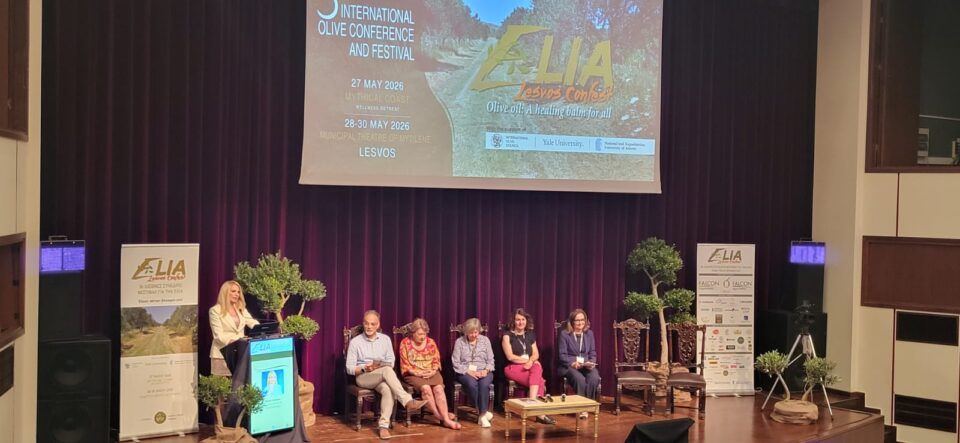
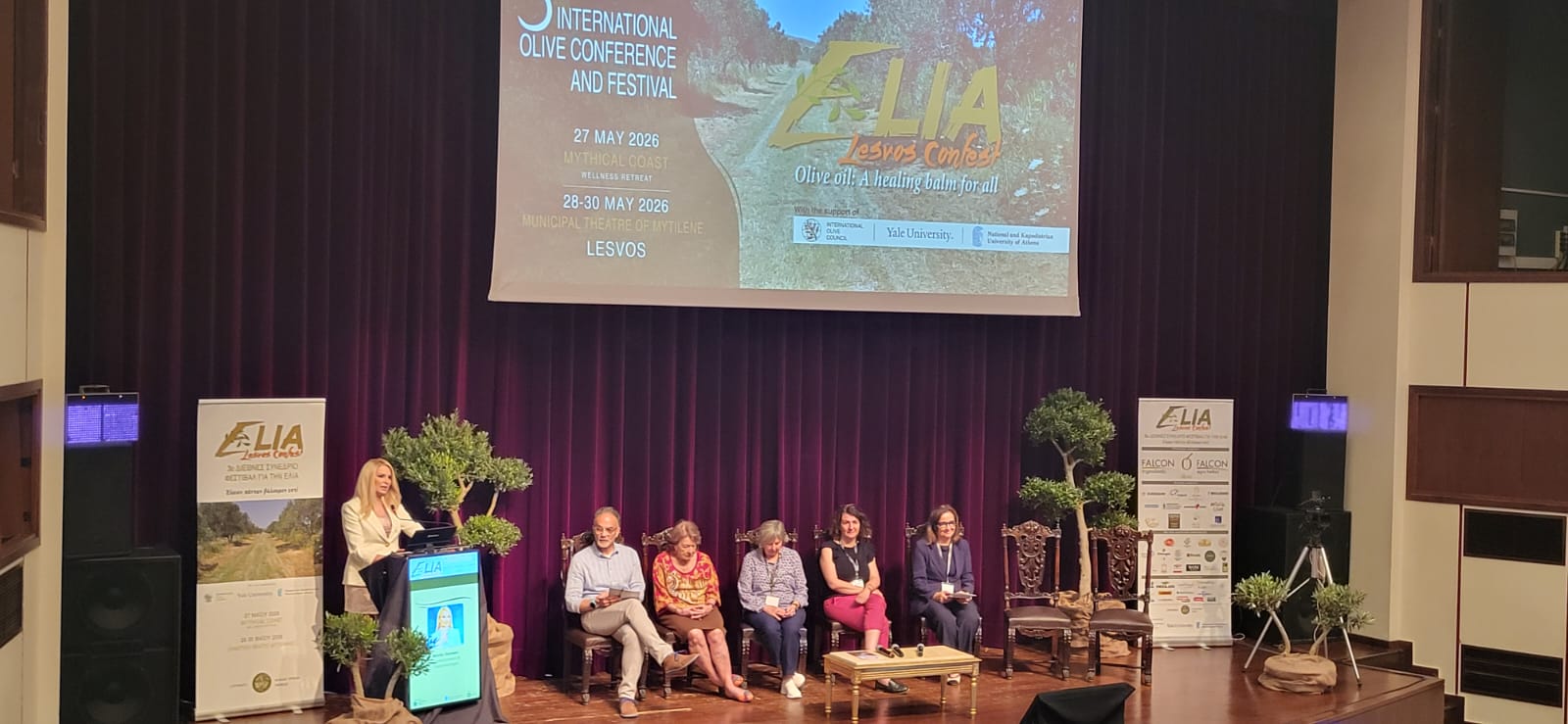
3rd ELIA Lesvos Confest Panel Speakers / Photo Credit: Emmanuel Karpadakis
How to Teach Consumers About Olive Oil’s Health Benefits, Other Advantages: Marketing via Oleotourism
Decisions made in the grove and in the mill make an enormous difference in the quality, flavor, and health benefits of olive oil. Like most olive oil conferences in 2026, the third ELIA Lesvos Confest considered olive oil’s benefits for both humans and the environment. Mentioning its association with a reduced risk of cardiovascular disease, type 2 diabetes, and premature death, Ramon Estruch Riba called olive oil “the best fat we can eat.”
Praising the “whole pattern” of the traditional Mediterranean diet and lifestyle, Antonia Trichopoulou, co-creator of the original Mediterranean diet pyramid, emphasized that olive oil “is the heart of the Mediterranean diet; we cannot have a traditional Mediterranean diet without olive oil.” An influencer from India explained that olive oil can also play an important role in Indian cuisine, where “it has changed our life,” as improvements in her family’s blood tests have shown after two years of olive oil use.
Olive oil’s health benefits are one of its main advantages in many consumers’ eyes, but it offers so much more. Several talks considered the need to educate the public about olive oil benefits, tasting, quality, storage, and uses. Others examined the best ways to market olive oil, such as communicating through stories and connecting with consumers’ emotions. Some mentioned that marketing, revenue generation, and education can be combined in a variety of experiential, sustainable olive oil tourism activities.
Speakers pointed out that oleotourism can highlight an olive oil’s place of origin and the landscape, tradition, culture, cuisine and history of the place, along with other local products. This combination of agrotourism and culinary tourism can include chefs and restaurant staff, whose use and presentation of olive oil in gastronomy can help enlighten the public regarding its flavors and value.
2026 Olive Oil Conference Considers Film, Outreach to Youth for a Bright Future
Another way to reach consumers, as a unique panel at this olive oil event showed, is through film and television, and at film festivals, where tasting events can occur alongside screenings of movies that feature olive oil. In addition to a striking visual element, film and TV offer memorable storytelling, product placement in a story that elicits feelings, and the popularization of locations for tourists.
With the population of both olive farmers and olive oil consumers aging in traditional olive oil producing countries, some panelists emphasized the need to reach a younger generation. Film, video, social media, and tourism can help with this, and so can schools and school trips. Advocating “intergenerational renewal” in a passionate exhortation, 35-year-old Spyros Dafnis explained how his team at The Governor and Corfu Olive Tours welcomes schoolchildren as well as tourists to their mill, groves, and olive oil bar.
With olive oil tourism and schoolchildren’s visits, benefits flow both ways. As Dafnis says, “we educate visitors, and they educate us; we simulate the market within our own mill” and see how consumers respond to their products. By carefully preparing an enjoyable, educational olive oil experience, as The Governor gradually did in ten years of work, they help to “forge a new reality of Greek olive oil. If the experience is positive, they will be with us forever.”
Having lived through the financial crisis in Greece, Dafnis believes “the biggest virtue for a Greek farmer or any person is to adapt to the conditions, and to be grounded while gazing toward the sky.” With uplifting success stories from different generations and parts of Greece, and numerous proposals for solutions to problems in the olive oil sector in 2026, the third ELIA Lesvos Confest offered a hopeful vision for the future of Greek liquid gold.
About the 3rd ELIA Lesvos Confest
Organized by Fotini Tirpintiri and The Cultural Association “Elaeas Nisos Lesvos” (Olive Island Lesvos), the ELIA Lesvos Confest bears the seal of the International Olive Council (IOC), confirming the value, quality and high level of the organization, as the organization grants this recognition internationally with strict criteria, while at the same time being supported by Yale University and the National and Kapodistrian University of Athens (NKUA).
For complete information about the conference program and speakers, see the Confest website. Thanks to Emmanuel Karpadakis for the photo.
Find out more about the area’s olive oil history and culture in Olive Oil from Lesvos, Greece: Economy, Cuisine and Culture. To learn about the previous Confest, see 2nd Internat’l ELIA Lesvos Confest Highlights Island’s EVOO.