
The ship that helped decide the Battle of Salamis had no engine, no cannon and almost no room to spare. Its power came from an astonishing feat of design: three stacked levels of oars, a bronze-armored ram and 170 human beings trained to move as one.
Seen from the outside, an ancient Greek trireme looks almost elegant: a long, low wooden hull, a narrow deck and a sharp prow reaching forward over the water.
Cut the ship open, though, and it becomes something else entirely.
Inside were 170 rowers packed into three staggered levels on each side of the vessel, each man controlling his own oar. Above and around them were officers, sailors, marines, a shipwright and even a musician whose job helped keep the rowing rhythm. At the bow sat the ship’s principal weapon: a ram designed to turn the entire weight and momentum of the vessel into a blow against an enemy hull.
A remarkable 3D animation highlighted by Open Culture, created by the YouTube channel Deconstructed, makes it possible to see this machinery from the inside. The animation is the perfect starting point because the trireme becomes much easier to understand once you realize that virtually everything about its shape was organized around one idea: converting coordinated human power into speed, maneuverability and violence at sea.
Three levels, 170 rowers, one stroke
The name tells part of the story. A trireme was built around three levels of oarsmen on each side of the ship—not three men pulling a single oar, but three vertically staggered banks of individual rowers.
According to the Hellenic Navy’s reconstruction of a Classical trireme crew, the 170 rowers were divided into 62 thranites on the upper level, 54 zygites in the middle and 54 thalamites on the lowest level. That meant 31 upper-row oars and 27 each on the middle and lower rows on either side.
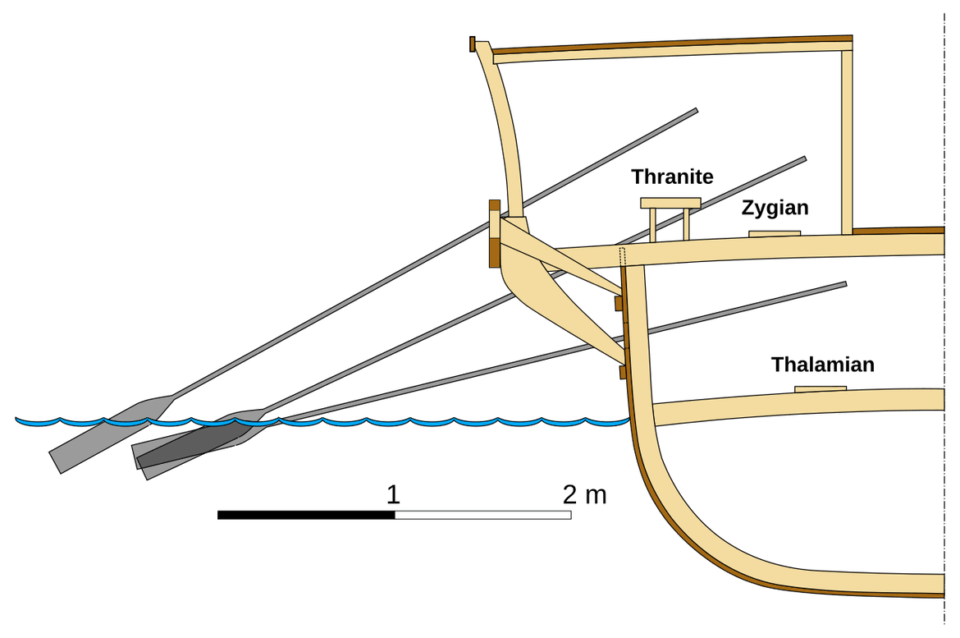
They were not simply stacked like bunk beds. The positions were offset vertically and outward so the oars could enter the water at different points without colliding. The upper rowers sat farthest outboard; the lowest worked close to the waterline. The geometry allowed a long, narrow hull to carry far more rowing power than a ship with a single bank of oars.
Ancient evidence makes the system feel strikingly personal. In Thucydides’ account of a surprise naval operation, sailors are described taking their own oars, rowing cushions and leather oar straps with them when moving overland to another fleet. The trireme may have been a sophisticated machine, but every unit of propulsion was still a human being with an oar in his hands.
The trireme was a crew, not just a ship
A full trireme complement approached 200 people. Around the rowers was a compact hierarchy built for command, navigation, maintenance and combat. The trierarch stood at the top of the ship’s organization. A skilled helmsman handled navigation and steering. A rowing master, the keleustes, directed the cadence. A piper or auletes helped sustain rhythm. There were sailors to handle the rigging and sails, a lookout at the bow, a shipwright for repairs and a small force of armed men—typically hoplites and archers—who could fight at close quarters.
The familiar movie image of an ancient galley powered entirely by chained slaves is too simple, at least for the Athenian navy. A remarkable late-fifth-century Athenian trireme crew inscription records citizens, foreigners and enslaved men serving aboard the same ships, alongside specialist officers and craftsmen. The exact social makeup varied over time, but the inscription shows how broad the manpower demands of a naval power could become.
And this is where the technology becomes extraordinary.
One hundred seventy rowers could not simply pull hard.
They had to pull together.
Built like a racing shell with a weapon in its nose
No intact Classical Greek trireme has survived for archaeologists to excavate. Our understanding comes instead from a combination of ancient texts, vase paintings and reliefs, the dimensions of ancient naval installations, comparative shipwreck archaeology and modern experimental reconstruction.
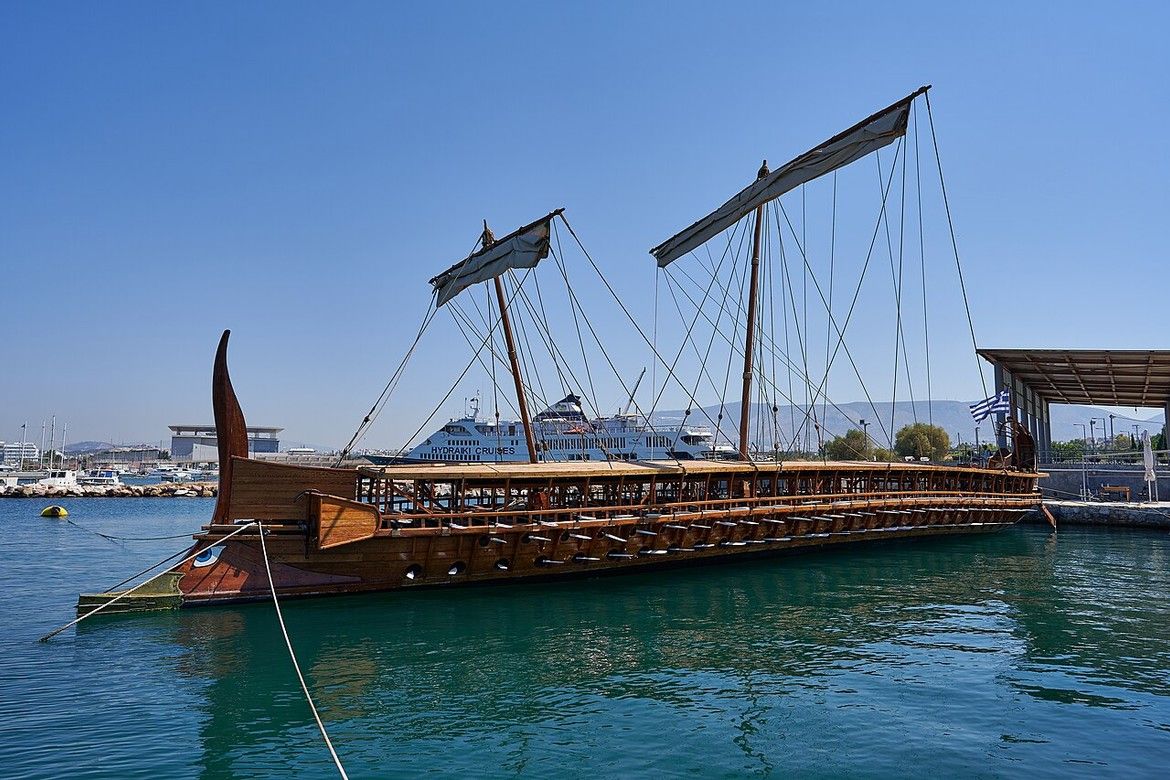
The most famous reconstruction is Olympias, a full-scale trireme built for the Hellenic Navy in the 1980s from research by historian John Morrison and naval architect John Coates. The Hellenic Navy describes Olympias as 36.9 meters long, only 5.5 meters wide and drawing about 1.25 meters of water—a vessel shaped for speed rather than cargo capacity or heavy protection.
Archaeology helps fill in the larger shipbuilding picture. The fourth-century BCE merchant ship excavated off Kyrenia, Cyprus, for example, preserves the sophisticated mortise-and-tenon construction tradition used by Greek shipwrights: hull planks carefully joined edge to edge before much of the internal framing was installed. A warship was a different vessel with different stresses, but it emerged from the same highly developed Mediterranean woodworking culture.
Athens also left behind something almost as revealing as a shipwreck: the infrastructure built to house its fleet. Archaeologists with the Zea Harbour Project have documented the remains of enormous shipsheds and slipways at Piraeus. The naval installations at Zea and Mounichia were not simply docks. They were a military-industrial landscape designed to store, protect, repair and rapidly launch one of the largest fleets of the ancient world.
The bronze ram was the gun
The trireme’s most intimidating weapon was not carried aboard it.
It was built into the ship itself.
At the bow, near the waterline, a heavy projection was reinforced with bronze. Rather than standing off and firing projectiles at another vessel, a trireme could use its speed and maneuverability to strike an enemy ship in the side or stern, damaging its hull and putting it out of action.
The goal was not reckless collision. It was controlled impact. A successful attack demanded the right angle, the right speed and enough control after the strike to avoid becoming trapped or exposed to another enemy vessel.
No bronze ram from an Athenian trireme at Salamis is known to survive. Later archaeological finds nevertheless show how formidable the concept became. The famous Athlit Ram, recovered off the coast of Israel and dating centuries after Salamis, is a massive cast-bronze naval ram weighing hundreds of kilograms. Its later date and different design mean it should not be treated as an exact model of a fifth-century Athenian weapon, but it demonstrates the extraordinary metalworking and structural engineering behind ramming warfare.
Fast—but not magic
Ancient writers praised triremes for speed and agility, but modern reconstruction has given historians something unusually valuable: the chance to test the idea on water.
During sea trials, crews aboard Olympias showed that three levels of rowers really could function together. A peer-reviewed reassessment of the Olympias trials places ordinary sustained rowing speeds in decent conditions at roughly four to five knots, with substantially higher speeds possible for shorter periods. Other trial reports recorded brief bursts approaching nine knots.
The more revealing achievement may have been maneuverability. A trireme was shallow, light for its length and driven by scores of independently powered oars on each side. By varying effort between port and starboard and using its steering equipment at the stern, a trained crew could accelerate, slow, pivot and change direction with a responsiveness that made sophisticated naval maneuvers possible.
Ancient tactical terms such as the diekplous—breaking through or exploiting gaps in an enemy line before turning to attack—and the periplous—maneuvering around a formation to reach a vulnerable flank or rear—only make sense in a world where crews could control their ships with exceptional precision.
The real engine was synchronization
This may be the most impressive part of the trireme.
A modern engine turns fuel into motion through machinery.
A trireme turned timing into motion through people.
Imagine 170 oars entering the water, biting, pulling and recovering again and again inside a wooden hull barely wide enough to contain the men operating them. A mistimed stroke could rob the ship of thrust or interfere with the rhythm around it. During an acceleration or turn, the entire crew had to respond to commands almost instantly.
The rowing master and the beat of the piper were therefore not decorative details of ancient naval life. They were part of the vessel’s control system. The ship worked only when the men inside it stopped behaving like 170 individuals and began behaving like one engine.
That is what the 3D animation captures better than almost any diagram. The engineering of the trireme was not hidden below deck in gears or pistons. It was distributed across the bodies of its crew.
Salamis: where the machine met the strategy
The Battle of Salamis in 480 BCE is the moment that made the trireme famous—but it is important to understand what actually happened. The Greeks did not defeat a Persian fleet because they possessed triremes and the enemy did not. Persian naval forces also relied heavily on triremes and included experienced Phoenician, Egyptian, Cypriot and Ionian crews.
The advantage came from how the Greek fleet, and especially the Athenians, used the ships.
Themistocles pushed for battle in the confined waters of the Salamis straits, where the Persians’ larger force could not exploit its numerical advantage as easily. The Greek Ministry of Culture’s account of the battle emphasizes how the narrow space compressed the battlefield and disrupted the Persian deployment.
Herodotus, writing within living memory of the Persian Wars, describes the battle beginning with ships closing and ramming one another and later contrasts the order of the Greek fleet with increasing confusion on the Persian side. His account contains the drama of individual ships and commanders, but beneath it is the same technological truth: these vessels were most dangerous when disciplined crews could maneuver them exactly where commanders wanted them.
Salamis was therefore not simply a triumph of a clever ship design. It was a triumph of ship design, geography, training, command and collective discipline coming together at the same moment.
The ship that remade Athens
The trireme’s greatest legacy may be that Athens built an entire system around it.
On the eve of the Persian invasion, a rich new vein of silver had been discovered at Laurion. Rather than distribute the windfall, Themistocles convinced the Athenians to channel the money into warships. Ancient sources differ over the precise accounting—Herodotus speaks of a program that produced 200 ships, while other traditions describe an initial hundred—but the strategic result is clear. According to the Greek Ministry of Culture, by 480 BCE Athens possessed roughly 200 triremes and had become the largest naval power among the Greek states.
That decision changed far more than a single battle. A fleet of that scale required timber, bronze, rope, sails, shipwrights, rowers, officers, training, wages, maintenance facilities and an enormous harbor complex. It tied the city’s military strength to thousands of ordinary men who could row. In the decades after Salamis, Athenian naval power would underpin the Delian League, protect maritime routes and help make Athens the dominant power of the Aegean.
The shipsheds uncovered at Piraeus are a reminder of the scale. The Zea Harbour Project estimates that the covered ship-storage complexes across the naval harbors approached 110,000 square meters. Athens did not simply own triremes.
It built a city capable of keeping them alive.
An ancient machine made of people
Nearly 2,500 years later, the trireme still feels unexpectedly modern because its sophistication is easy to recognize.
Its designers solved problems of weight, hydrodynamics, leverage, structural strength and human ergonomics without engines, computer modeling or modern materials. Its commanders developed tactics around acceleration, turning radius and formation. Its crews learned to synchronize hundreds of moving parts—except those moving parts were people.
The bronze ram mattered.
The three rows of oars mattered.
The narrow hull mattered.
But the real technology of the trireme was the system that connected all of them.
Wood, bronze, geometry and 170 beating hearts, all moving on command.