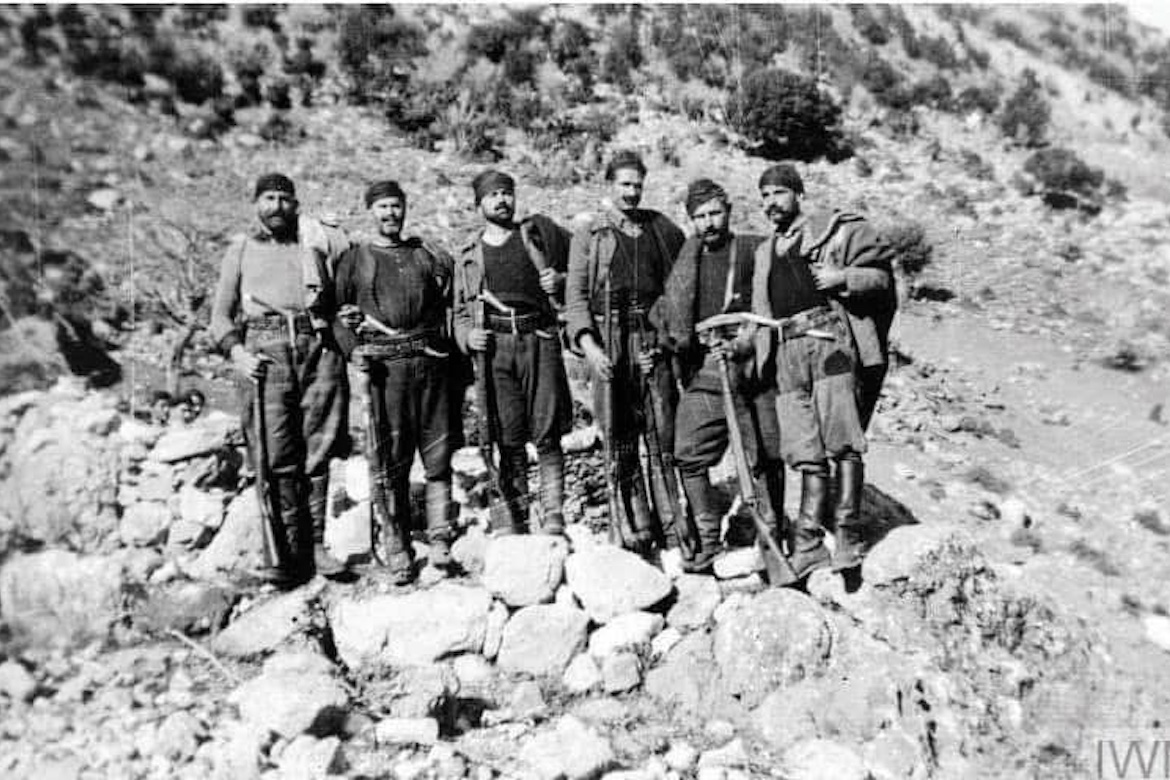

An old black-and-white photograph began circulating on social media that caught my attention. At first glance, it looks like any wartime relic— a group of men standing proudly in rough terrain, rifles in hand. But to anyone who knows the island’s history, it’s far more than that.
Taken in July 1942, near the Rouvas forest on Mount Psiloritis, the image shows the founding members of one of Crete’s most storied resistance units— The team of resistance fighters led by Captain Giorgis Petrakis (known as Petrakoyiorgis).
These were the men who defied the Nazi occupation, who risked everything for the island’s freedom.
Standing beside their legendary captain (first from the left) are five partisans, all from the village of Voriza: Manolis Veisakis (“Manousomanolis”), Giorgis Faragoulitakis (“Skoutelogiorgis”), Giorgis Kargakis (“Psarogiorgis”), Dionysis Frangiadakis (“Tselekodionysis”), and Giorgis Charalambakis (“Balaskas”).
They had already fought in the mountains of Albania during the Greek campaign and returned home carrying the same Manlicher rifles— and an oath that echoed across centuries:
“Οὐ καταισχυνῶ ὅπλα τὰ ἱερά” — “I shall not disgrace the sacred weapons.”
The line comes from the Ephebic Oath of Ancient Athens, a pledge sworn by young men as they entered adulthood and military service. It meant defending one’s homeland and honor without shame, standing beside one’s comrades, and leaving the country better than they found it.
These men lived it.
With those same rifles, they fought again— this time against the Nazis, defending their villages and one another.
And here’s the haunting detail: in that same photograph stand ancestors of the two families now locked in the vendetta that has once again made Voriza a national talking point. Eighty years ago, their grandfathers fought side by side. Today, their descendants fight each other.
At the battle of Trachili in August 1943, Tselekodionysis was killed. The Manlicher of Psarogiorgis— the very one in this photo— took three bullets in its stock. A small roadside shrine now marks the spot where Frangiadakis fell. Kargakis’ rifle rests in the Historical Museum of Crete.
It is said by the locals that a copy of this photograph still hangs in nearly every home in Voriza.
If only, before reaching for their guns, the grandchildren would stop and look— really look— and remember that their forefathers once took up arms NOT against each other, but against tyranny itself.
The original photograph is attributed to Patrick Leigh Fermor and belongs to the Imperial War Museum. The image was shared by Giorgos Papadakis that appeared on my newsfeed.