
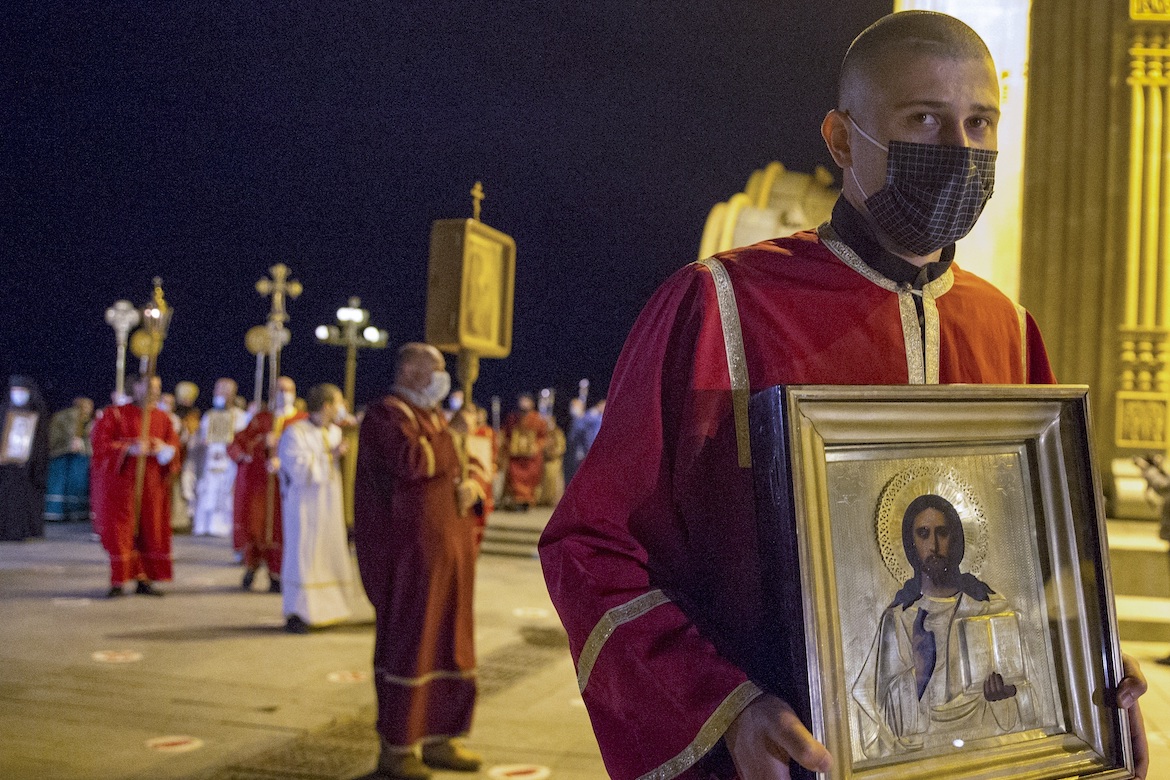
As Americans become more restless after almost two months of lockdown and shuttered churches, and states begin to ease restrictions of movement, various initiatives have popped up on social media to pressure hierarchs to re-open Greek Orthodox Churches.
Perhaps as a response to the growing pressure and louder voices to open parishes across the nation, the Greek Orthodox Archdiocese of America issued a statement that each Metropolis would announce plans to re-open at the discretion of local authorities.
Archbishop Elpidophoros of America also shared a Tweet, calling for faithful to be patient, telling them that churches will open “with wisdom and prudence.”
“We are anxious to re-open our churches, and we will do so with wisdom and prudence. But what should be opened as wide or wider are minds and hearts so that our Faith is a witness to love, and not an excuse for any triumphalism,” Archbishop Elpidophoros posted on Twitter.
Various posts began appearing before Easter asking officials why liquor stores were considered “essential businesses” and were allowed to stay open during the strict stay-at-home orders while churches were forced to close.
As early as April 1, when the daily death toll was at its peak in various American cities, others used their professional credentials to promote false claims that “the World Health Organization has come out with new guidelines which should be supportive of reopening the churches.”
Amelia Bartholomew, a medical doctor and professor at the University of Illinois at Chicago circulated an email that was obtained by The Pappas Post asking fellow “brothers and sisters in Christ” to circulate her findings in “support of opening the churches” and encouraging the restoration of the sacrament of Holy Communion in parishes.
“Since our faith unequivocally holds true that the body and blood of Christ is incorrupt and can never serve to transmit disease, but instead strengthens the health of our souls and bodies, one would conclude that in these difficult times, communion is necessary and required to heal our souls and bodies in this difficult time. To deny access to salvific Christ in response to this pestilence is to deny Christ Himself,” Dr. Bartholomew said in her email.
Shortly after this doctor’s push to re-open parishes emerged, Metropolitan Nathanael of Chicago brought together a team of medical and police officials in a one-hour webcast that directly refuted this doctor’s claims and further explained to faithful why it was necessary to keep churches closed and act responsibly to prevent the spread of the disease, especially to the elderly population.
In a response to a question about the pressure campaign to re-open churches earlier than planned, Metropolitan Nathanael via email responded to The Pappas Post, calling the effort “deceptive, reckless, and irresponsible.”
“The decision to limit the participation of our people in Church services was not an easy one. It was painful and it was only reached after much prayer, after consultation with doctors and emergency management professionals who are faithful stewards of our Church, and after deliberation with the Holy Eparchial Synod. At that time, my goal was to do all that I possibly could to protect our people and our neighbors; this still remains a priority.
“I don’t expect everyone to fully grasp the numerous factors being considered. When you take into account the conflicting and confusing pieces of information being shared through social media channels, it is expected to have people disagree with my decision.
“While different opinions are always welcome—they may even help us make better decisions over time—deception is not. To have one of our faithful selectively cite evidence in an effort to assemble a pressure campaign to force a premature change in course is deceptive, reckless, and irresponsible. Such behavior, whether they stem from the laity or clergy, are intolerable since they place people’s lives at risk.
“These are trying times that require each of us to cultivate important virtues, including discernment, patience, and humility. I have faith that by God’s grace and the guidance of our brothers and sisters in Christ who happen to be doctors, scientists, and emergency management experts, we will emerge from this crisis as a stronger and more vibrant community. Disagreement can be part of this process, but deception cannot.”
Given the Orthodox Church’s complicated structure and hierarchy with no central authority, the Church’s response has been as disparate and diverse as the languages that are used to preach across the vast Orthodox world.
The Church of Greece resisted initial calls to halt services, until the Greek government forced them to close. Apart from a few outbursts on social media and a few renegade priests who held “secret services” that were nothing but publicity stunts, the Church and faithful abided by the rules– even during Holy Week and Pascha, the most sacred time of year for Greek Orthodox Christians.
Churches across the country were permitted to re-open this week for individual prayer and services will be allowed to begin in mid-May with strict distancing guidelines.
Churches under the Ecumenical Patriarchate of Constantinople closed on March 18 following a directive by Ecumenical Patriarch Bartholomew, without much resistance apart from isolated outbursts on social media and a few rebel priests.
In Serbia, a prominent bishop in the Serbian Orthodox Church died from a coronavirus infection. Bishop Milutin Knezevic, 71, and two other priests from the Valjevo diocese tested positive.
Serbia declared state of emergency and suspended public gatherings to curb the spread of the virus in mid-March and Patriarch Irinej banned all services and asked faithful to watch them on TV.
But after an outcry from conservative forces within the church, priests continued their practice of offering communion from a common chalice for faithful who gathered outside churches.
Other jurisdictions, especially the Russian Orthodox Church, have been decimated, with entire parishes and monastic compounds becoming hotspots of the disease with dozens upon dozens of deaths, including one high-ranking bishop.
The Russian Church failed to implement a tough stance from the beginning of the crisis, with some priests even mocking the virus and encouraging faithful to “laugh at masks.”
A popular Russian priest with more than 400,000 followers on YouTube put on a gas mask and shrugged off the virus, encouraging everyone to “laugh at this nasty devilish thing” and “switch off the television, then there will be no coronavirus.”
Others even encouraging mass displays of blatant disregard for health concerns when a Cathedral in St. Petersburg welcomed thousands of faithful to kiss a container that was believed to contain bone fragments of St. John the Baptist.
It wasn’t until numerous high-profile deaths that Patriarch Kirill issued a harsh warning to rebel priests, but by then it was too late and the virus had already taken a terrible toll on the rank and file of the Russian Church, as well as the faithful.