

The Greek middle class, long considered the backbone of the country’s economy and democracy, is today smaller, poorer, and under heavier tax pressure than its European counterparts, according to data from the Piraeus Chamber of Commerce and Industry (EBEP).
Defined by the OECD and Eurostat as households with disposable income between 75% and 200% of the national average, Greece’s middle class in 2024 can include individuals with gross earnings between €10,000 ($11,700) and up to €24,000 ($28,100) annually, or households of four earning €24,000 ($28,100) to €60,000 ($70,260).
At €11,000–€12,000 ($12,880-$14,050) per person, Greece’s average disposable income remains well below the EU average. Thus, according to EBEP President Vassilis Korkidis, Greece’s middle class and its small- and medium-sized enterprises (SMEs) are “smaller in scale, poorer in income” compared to their Eurozone counterparts.
Furthermore, Greek households also receive fewer public benefits, unlike their European counterparts where heavy taxation is offset by strong welfare systems in healthcare and education. Furthermore, a large share of income in Greece is absorbed by direct and indirect taxes, leaving less for consumption and savings.
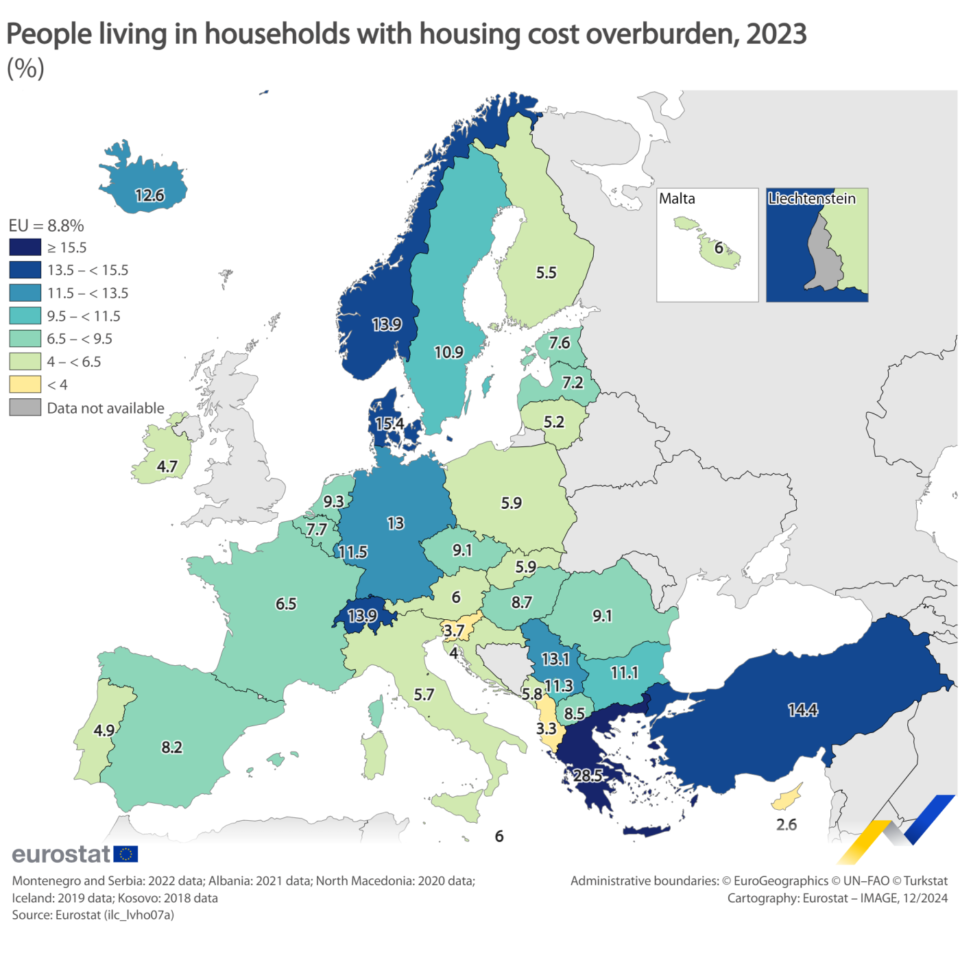
Then, there’s the housing crisis also affecting Greece’s middle class. Αccording to Eurostat, 28.5% of Greeks live with housing overburden, the highest in the EU. In Cyprus this figure is 2.6%, the lowest in the EU.
The Greek middle class has traditionally included civil servants, private sector professionals, and small business owners. The relationship between the Greece’s middle class and SMEs is described as “crucial and two-way,” with each feeding and supporting the other, and now struggling with the same fiscal burdens.
This means that, as Greece attempts to stabilize after years of crisis, a shrinking middle class will affect SMEs directly — and without targeted relief and stronger support systems, a “compressed” middle class may undermine both economic growth and social cohesion.