
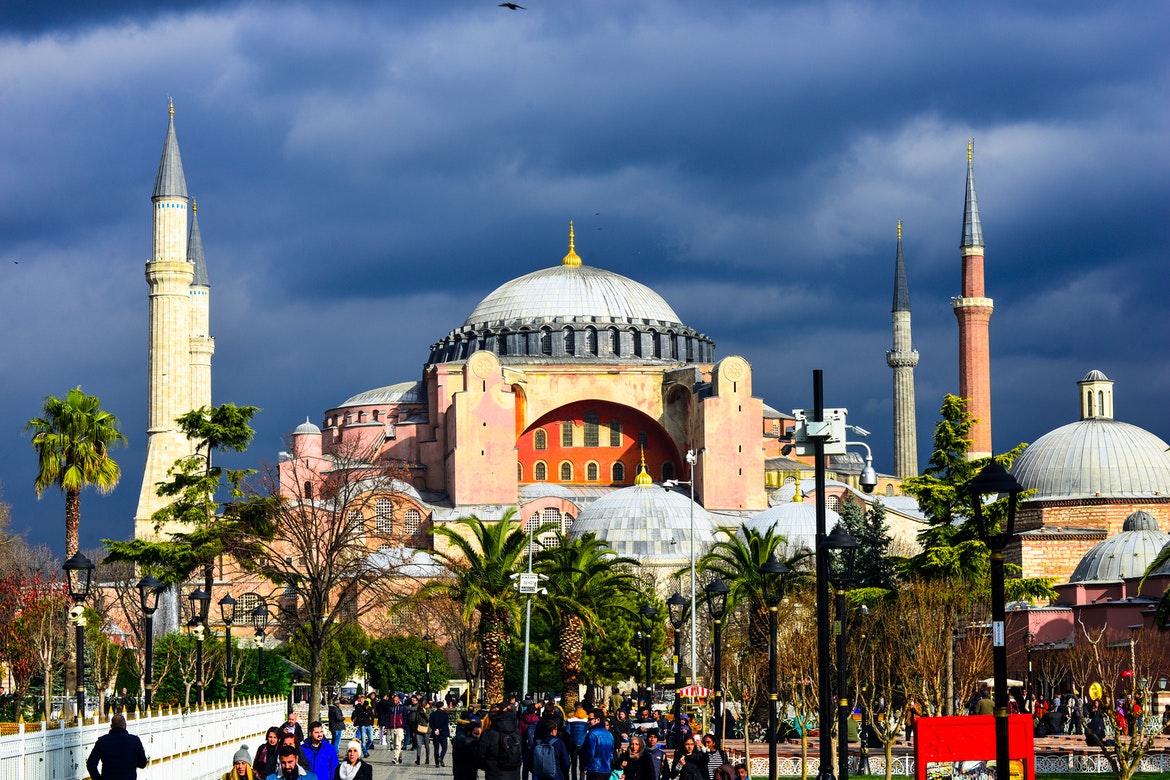
Turkish President Recep Tayyip Erdogan signed a decree on Friday formally converting Hagia Sophia into a mosque within hours of a high court’s decision permitting the move, according to a report from The Washington Post.
Erdogan declared Hagia Sophia open for Muslim worship after 86 years of the UNESCO World Heritage Site functioning as a museum open to all visitors.
With support from his conservative muslim base, the Turkish president has long sought this outcome while struggling to maintain popularity with voters during 18 years in office.
But Erdogan’s actions have received condemnation from religious and political leaders throughout the world.
Last Wednesday, U.S. Secretary of State Mike Pompeo issued a statement urging Erdogan’s government not to violate Hagia Sophia’s UNESCO status.
“We urge the Government of Turkey to continue to maintain the Hagia Sophia as a museum, as an exemplar of its commitment to respect Turkey’s diverse faith traditions and history, and to ensure it remains accessible to all,” Pompeo tweeted.
In late May, numerous U.S. organizations slammed the Turkish president’s actions and the Chicago-based Hellenic American Leadership Council started an online petition encouraging UNESCO to protect the site.
And on Monday, the Russian Orthodox Patriarch Kirill of Moscow said he was “deeply concerned” by Turkey’s plans.
“A threat to Hagia Sophia is a threat to the entire Christian civilisation and, therefore, to our spirituality and history,” Kirill said. “To this day Hagia Sophia remains a great Christian shrine for every Russian Orthodox believer.”
The court decision that cleared the way
A Turkish court had issued a decision earlier Friday determining that the sixth-century former cathedral could be converted into a mosque.
The group that brought the case to court had contested the legality of the 1934 decision by the modern Turkish republic’s secular government ministers and argued that Hagia Sophia was the personal property of Ottoman Sultan Mehmet II, who conquered Istanbul in 1453.
According to the aforementioned report from The Washington Post, the court ruled that the building was the property of a foundation managing the Sultan’s assets and was opened up to the public as a mosque.
What comes next
Uncertainty also looms over what will happen to the site’s various mosaics depicting Holy Family and portraits of imperial Christian emperors — imagery that would clash with strict Muslims entering the building for religious purposes.
According to a report from the Turkish daily, Hurriyet, officials from Erdogan’s Justice and Development party suggested holding the first Muslim prayers in Hagia Sophia on July 15, which marks the four-year anniversary of a failed coup attempt against Erdogan’s government in 2016.
The move could also deepen tensions with neighboring Greece.
Brief history of Hagia Sophia
Built in 537 by the Byzantine Emperor Justinian I, Hagia Sophia once served as the seat of the Ecumenical Patriarch but was converted into a mosque after Constantinople fell to the Ottoman Empire on May 29, 1453.
Turkey’s first president, Kemal Ataturk, secularized Hagia Sophia and opened it as a museum in 1934. In 1985, UNESCO designated the site — as a component of the Historic Areas of Istanbul — a World Heritage site.
The building was Turkey’s most popular museum in 2019, drawing more than 3.7 million visitors.