
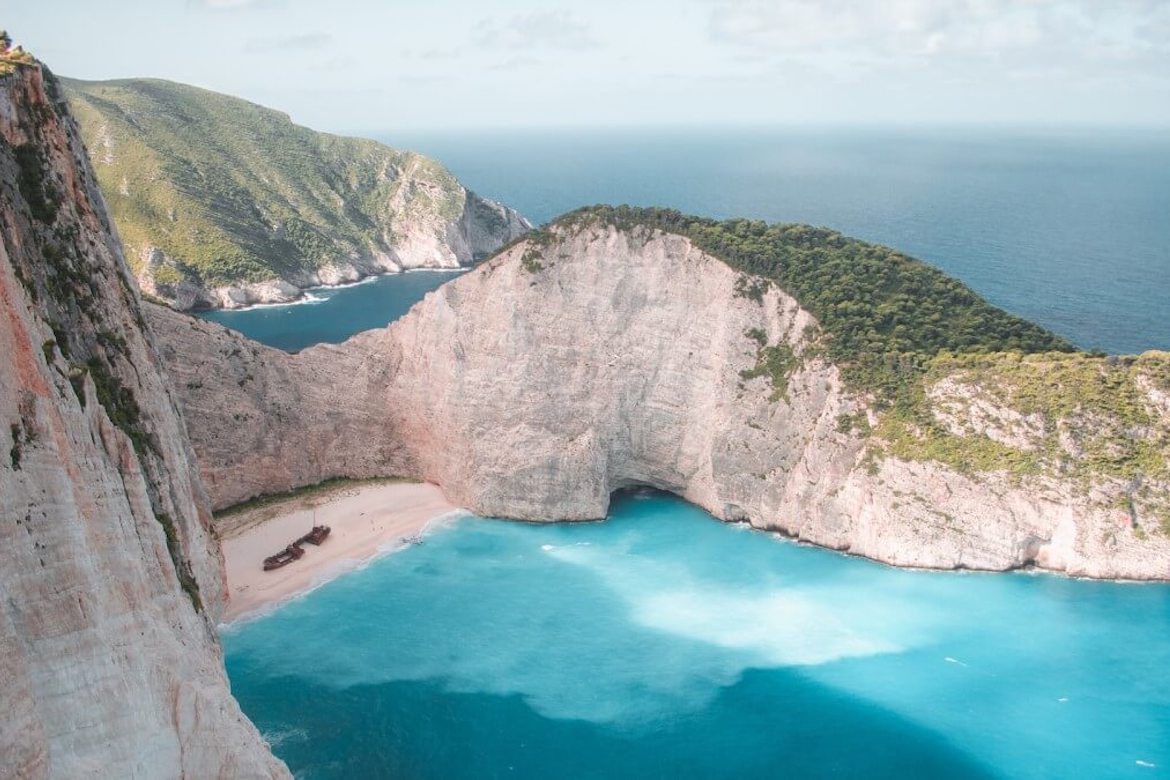
The Greek government has announced that it will extend the ban on entry to the world famous “Navagio” beach on the Ionian island of Zakynthos following geological inspections that deemed the location unsafe.
Inspections were carried out by the country’s Anti-Seismic Planning and Protection Organization (OASP) checking for seismic activity and landslide potential.
A statement issued on March 16 by the Greek Ministry of Tourism revealed that the inspection performed on March 8 suggested a significant risk of landslides due to strong erosion on the surrounding slopes.
The meeting took place between the Ministry of Climate Crisis, Civil Protection, the Ministry of Island Policy, the Ministry of Tourism, the Greek Police, the Coast Guard, and the Region of the Ionian Islands, under the coordination of the Presidency of the Government, for the implementation of the ban on entry to the “Navagio” beach for the entire 2023 tourist season.
Based on the findings, it was also agreed that the situation be reassessed twice a year.
“The safety of residents and travelers is above all, and the decision was taken taking into account the new scientific data of the OASP and the President of Professor E. Lekkas, given the high number of visitors to the area during the tourist season,” the Minister of Tourism Vassilis Kikilias pointed out in this regard.
Back in 2018, seven people, among them two children, were injured due to the collapse of a 200-meter-high rock in this beach. Meanwhile, the most severe case to date was a spinal fracture suffered by a 34-year-old Czech woman.
The 2008 collapse was captured on video by multiple beachgoers and videos went viral on social media at the time.
In September 2022, a massive landslide was also reported due to a 5.4 magnitude earthquake, as a result of which the beach was closed. However, the authorities have allowed tourists to visit this Instagram-famous site, but only by water, as entering the sand or swimming near the ruins was strictly prohibited.