

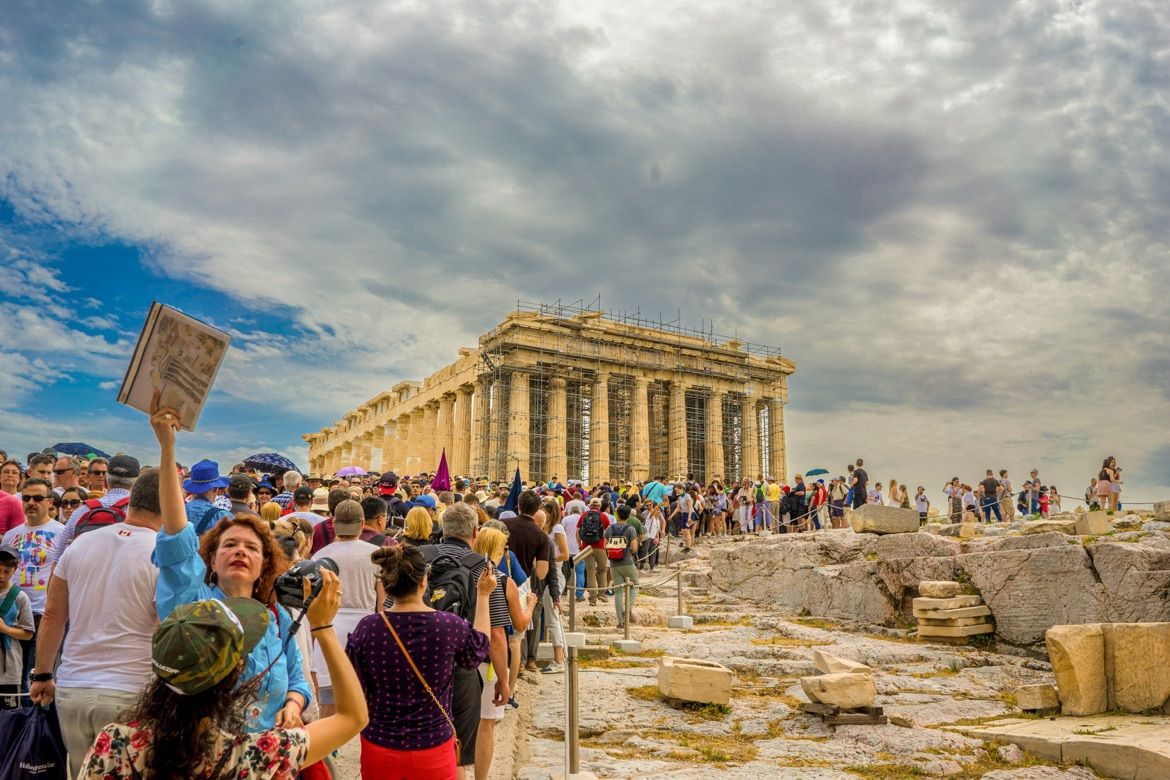
For years, the American trip to Greece began with a familiar calculation: first get to New York, Philadelphia, Washington or another major transatlantic gateway, then cross the Atlantic—sometimes through a European airport—before finally reaching Athens.
That calculation is changing. New nonstop flights from Charlotte and Dallas–Fort Worth have moved Greece closer to large parts of the Southeast, Texas and the central United States. In May 2027, Seattle will give the Pacific Northwest its first direct connection to Athens.
At the same time, Greece keeps appearing before Americans in other ways: in films and television series, in celebrity vacation posts and across social feeds. The result is not necessarily a dramatic surge in the number of American visitors. It is something more durable—and, for Greece, more valuable. Greece has become easier to reach, more familiar to imagine and increasingly attractive to travelers who spend heavily once they arrive.
The American visitor is becoming more valuable
The newest numbers complicate the easy headline that Americans are simply “flocking” to Greece.
According to final Bank of Greece data for 2025, approximately 1.55 million U.S. residents visited Greece, an increase of just 0.2 percent from 2024. Receipts from American travelers, however, rose 9.7 percent to approximately €1.74 billion.
The first half of 2026 sharpened that distinction. U.S. arrivals fell 5.4 percent to 656,700, while receipts from American travelers climbed 10.8 percent to €796.9 million.
In other words, the American market became more valuable even as fewer Americans arrived.
That pattern has been building for years. Bank of Greece analysis found that U.S. receipts more than doubled between 2014 and 2024, while Americans accounted for a much larger share of tourism income than of arrivals. In 2024, the average American visitor spent about €1,022 per trip, compared with €653 for a visitor from the euro area.
This helps explain why airlines, airports and tourism businesses pay such close attention to the United States. Greece does not need an endless rise in raw visitor counts for the market to matter more. Longer-haul visitors who stay, dine, shop, move between regions and choose higher-priced experiences can have an outsized effect.
The airplane map has changed
The structural shift is visible on an airline departure board.
For decades, nonstop travel to Greece from the United States was associated mainly with New York and a small group of traditional East Coast gateways. The Northeast still matters enormously, but it no longer defines the map.
Athens International Airport’s 2026 route-development material shows U.S. service rising from 46 weekly flights in 2019 to 82 in 2024 and 103 in 2026—a 124 percent increase from the pre-pandemic level. Athens says it is now directly connected with nine U.S. destinations.
That growth is about more than seats. It changes who can reach Greece conveniently and how much friction sits between the idea of a trip and the booking.
Charlotte, Dallas—and now Seattle
American Airlines opened its Charlotte–Athens route in 2025. The airline included Athens in what it described as its largest transatlantic schedule from Charlotte, its second-largest hub.
The practical significance is simple. A traveler from the Carolinas—or from dozens of communities across the Southeast feeding into Charlotte—can connect at a major regional hub and then fly directly to Athens. There is no need to position through New York, Philadelphia or Washington, and no additional change of aircraft in Europe.
Dallas–Fort Worth extended the same logic westward in May 2026. American’s largest hub gives Greece a direct gateway into Texas, the Southwest, the Mountain West and an enormous domestic connecting network. American called Dallas its fifth U.S. nonstop gateway to Athens.
For someone in Texas—and for passengers connecting into Dallas from across the central and western United States—Greece can now be one domestic connection followed by a single transatlantic flight. That is a very different proposition from backtracking to the Northeast or navigating a second connection in Europe.
Then came the announcement that most clearly shows how far the map has moved. On August 20, Alaska Airlines announced the first-ever nonstop service between Seattle and Athens.
The flight will begin May 12, 2027, operate three times weekly and use a Boeing 787-9 Dreamliner. Alaska describes it as the longest route in the airline’s history and says that, when it begins, it will be the only nonstop flight between the U.S. West Coast and Athens.
Seattle is not simply another dot on the route map. It means travelers from the Pacific Northwest will no longer have to cross the United States to reach an East Coast gateway or change planes in Europe. It also connects Alaska’s broad western network directly into Athens.
The geography of the American trip to Greece is changing. Charlotte brought Greece closer to the Southeast. Dallas opened a direct door from Texas and the central United States. Seattle will do the same for the Pacific Northwest in 2027. Because all three are major airline hubs, the effect reaches far beyond the people who live in those cities.
Greece keeps appearing on the screen
Access is one half of the story. Familiarity is the other.
Mamma Mia! turned the green landscapes and blue coves of the Sporades into an international fantasy; the Hellenic Film Commission lists Skiathos, Skopelos and Volos among its Greek filming locations. Glass Onion: A Knives Out Mystery gave Netflix viewers a modern, high-design Greece through Amanzoe near Porto Heli. Netflix later showed viewers exactly how the resort’s Villa 20 became the billionaire’s compound seen in the film.
Then Maestro in Blue carried the quieter Ionian beauty of Paxos into homes around the world. Each production presented a different Greece: not only the whitewashed Cyclades already familiar from tourism advertising, but forested islands, secluded Peloponnesian coastlines and lived-in village settings.
Christopher Nolan’s The Odyssey may add the largest burst of screen exposure yet. But it is one example within a much bigger pattern, not the beginning of it. The relevant question is not whether one film will produce an instant tourism boom. It is how another globally distributed image of Greece will land on top of years of growing visibility and access. The Pappas Post has followed the film’s enormous cultural reach; its tourism impact will become measurable only with time.
From watching Greece to booking Greece
The travel industry has a name for trips inspired by places seen in films and television: “set-jetting.” In plain English, viewers see a location on a screen and decide they want to experience it themselves.
Expedia’s 2026 set-jetting research identified the Peloponnese among its destinations to watch in connection with The Odyssey. Across Expedia’s research, roughly two-thirds of travelers said films and television had influenced their travel choices, with younger travelers especially open to turning screen inspiration into a real itinerary.
Social media compresses that path even further. A film may build an image of a place over months or years. A post can transmit it instantly—often accompanied by a location tag, a hotel name and a stream of comments asking how to get there.
None of this proves that a single title or viral photograph caused a booking. Travel decisions are usually messier than that. Airfares, schedules, family calendars and budgets still matter. But screen exposure reduces one of the less visible barriers: uncertainty. A destination seen repeatedly begins to feel knowable.
When celebrities become unofficial tourism campaigns
Celebrity travel operates in much the same way, with an audience already assembled.
Madonna celebrated her 68th birthday in Greece in August 2026. Her journey included Corfu, Meteora and Patmos, and she shared a version of Greece built around village music, dancing, spiritual sites and cultural encounters. As The Pappas Post reported in Eat, Pray, Dance: What Madonna Found in Greece, the trip was interesting not as celebrity gossip but because of the Greece she chose to experience and transmit to millions of followers.

That is a form of tourism marketing Greece does not have to purchase: a globally followed person visits, documents the experience and sends Greek images across millions of phones.
Justin and Hailey Bieber offered another version of that effect during a return trip to Greece in summer 2026. Reliable Greek reporting placed the family in the Kranidi and Ermionida area of the Peloponnese and on Spetses. They had also traveled through Greek islands in 2021.
The useful point is not the mechanics of a celebrity holiday. It is geography. Corfu, Meteora, Patmos, Ermionida and Spetses expand the global image of Greece beyond the familiar Mykonos–Santorini circuit. Every widely shared visit can introduce another coastline, island or inland community to an audience that may never have considered it.
Why Greece fits this American travel moment
Greece now sits at the intersection of several powerful American travel impulses.
It offers deep cultural meaning without requiring an expedition. It can be a history trip, a beach trip, a food trip, a family trip or a screen-inspired trip—and often several of those at once. Direct flights make a complex-looking itinerary feel manageable. Repeated appearances in entertainment and social media make the country feel familiar before the traveler has opened a booking site.
Most important, Greece is beginning to occupy a different place in the American imagination. It is less often framed only as the once-in-a-lifetime journey that must wait for a perfect anniversary, retirement or distant “one day.” More routes and a broader range of visible destinations make return trips—and trips focused on one region—easier to imagine.
For an American traveler, Greece is increasingly present before the journey begins: on a screen, in a social feed and now on an airline departure board much closer to home.
Nolan may add another enormous burst of visibility. Madonna and Bieber may send Greek images across millions of phones. But those cultural moments are landing on top of something structural: more access, more familiarity and an American traveler increasingly willing to spend substantially on Greece.
Greece is no longer merely somewhere many Americans imagine visiting “one day.”
For millions more of them, it is becoming a place they can reach on a single airplane.