
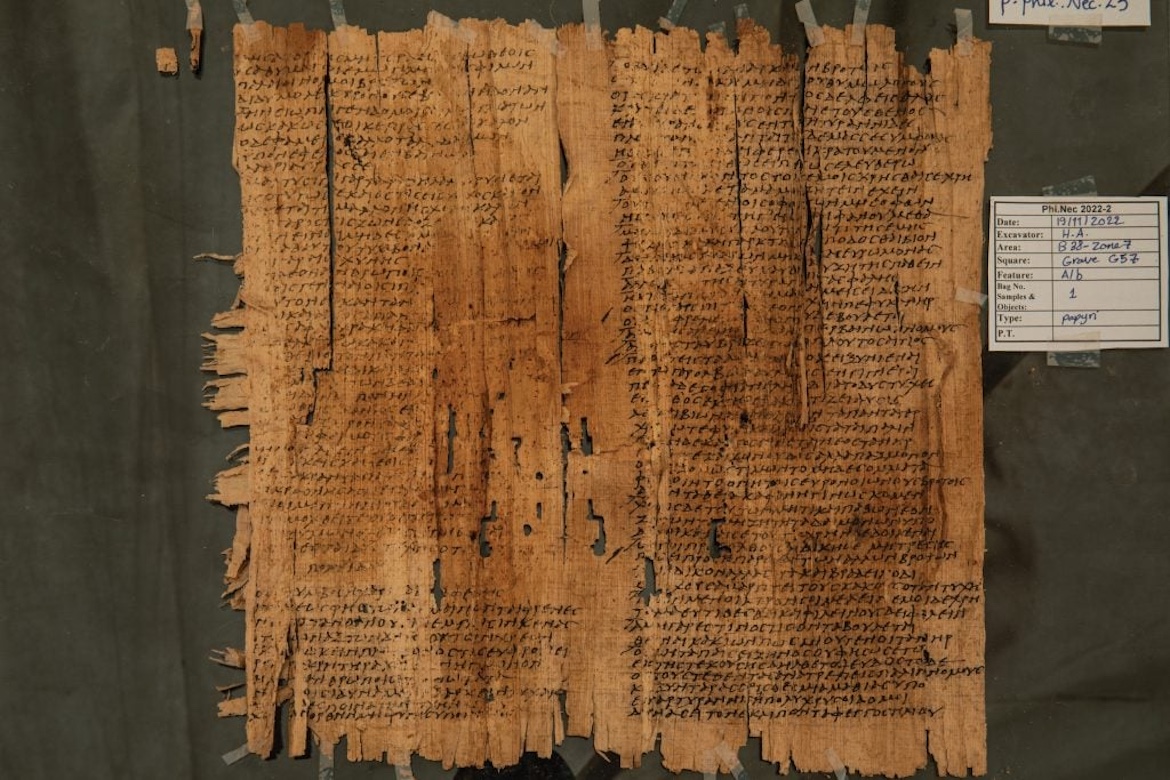
In one of the most significant developments for the study of ancient Greek literature, two scholars from the University of Colorado Boulder have identified previously unknown fragments of works by the famed tragedian Euripides.
These fragments, unearthed from a papyrus found at an ancient Egyptian burial site, represent the most important discovery of Euripidean texts in over half a century. The scholars, Assistant Professor Yvona Trnka-Amrhein and Professor John Gibert, believe these fragments are from two of Euripides’ largely lost plays, Polyidus and Ino.
The Discovery: A Rare Find in Classical Studies
The story began in November 2022 when Basem Gehad, an archaeologist with the Egyptian Ministry of Tourism and Antiquities, sent a photograph of a papyrus fragment to Trnka-Amrhein. The papyrus, excavated from the ancient site of Philadelphia in Egypt, contained 98 lines of Greek text.
Trnka-Amrhein, with her expertise in classical studies, quickly recognized the text as belonging to the genre of tragedy. After consulting the Thesaurus Linguae Graecae, a digital database of ancient Greek texts, she confirmed that the lines were previously unknown excerpts of Euripides’ work.
Realizing the potential significance of the find, Trnka-Amrhein enlisted the help of her colleague, Professor John Gibert, a specialist in Euripides fragments. Together, they spent months meticulously studying the 10.5-square-inch papyrus fragment, deciphering and verifying the text to ensure its authenticity and alignment with known tragic style and meter.
Their efforts paid off, revealing that the fragment contained material from two of Euripides’ lost plays: Polyidus and Ino.
Polyidus: A Mythical Tale with a Happy Ending
Polyidus recounts the story of King Minos and Queen Pasiphaë of Crete, who demand that the seer Polyidus resurrect their son Glaucus after he drowns in a vat of honey. Unlike many Greek tragedies that end in death and despair, Polyidus offers a relatively happy conclusion. The papyrus fragment includes a scene in which King Minos and Polyidus debate the morality of resurrecting the dead. The play culminates in Polyidus successfully reviving Glaucus using an herb he observed one snake use to revive another.
This discovery sheds new light on Euripides’ approach to storytelling, showing a rare instance where the tragedian explored themes of life, death, and resurrection with a more optimistic resolution. Trnka-Amrhein’s identification of this fragment is particularly significant, as it adds to our understanding of how Euripides might have engaged with and interpreted mythological themes in ways that differ from his more famous works.
Ino: A Darker, More Traditional Tragedy
The second play, Ino, is based on the life of Ino, the aunt of the god Dionysus and a member of the Theban royal family. Previous fragments of Ino depict her as an evil stepmother intent on killing her husband’s children from a previous marriage. However, the new fragment reveals a different plotline, where Ino herself is the victim. In this version, Ino’s children are targeted by the king’s third wife, who ultimately meets a tragic end after Ino turns the tables on her.
This fragment enriches our understanding of the character dynamics and thematic complexity in Euripides’ work. The discovery that Ino may have included alternate plotlines highlights Euripides’ tendency to rework and reinterpret myths, offering different perspectives and moral ambiguities within his plays.
Gibert’s expertise in Euripides fragments allowed for a thorough analysis of these newly uncovered lines, confirming their place within the broader context of the tragedian’s works.
The Significance of the Discovery
The importance of this discovery cannot be overstated. Trnka-Amrhein and Gibert believe that these fragments represent the most significant find of Euripidean texts since the 1960s. The papyrus, unusually large for a discovery in modern times, provides valuable new material that contributes to the ongoing scholarly efforts to reconstruct lost works of ancient Greek literature.
The discovery also underscores the potential for more unknown works to be found, particularly in regions like Egypt, where the dry climate has preserved ancient texts. The collaboration between archaeologists and classicists, exemplified by the work of Trnka-Amrhein and Gibert, continues to be crucial in uncovering and interpreting these remnants of the past.